

Authors /
Yeghia Tashjian, MA
Nareg Seferian, PhD
Thomas Becker, JD
Salma Waheedi, JD
Abstract
This work examines the forced deportation of Armenians from Nagorno-Karabakh (also known as Artsakh in Armenian) by Azerbaijan, defining it as ethnic cleansing. Drawing on Freedom House’s comprehensive report on the topic, and the resolution passed by the International Association of Genocide Scholars (IAGS) on Nagorno-Karabakh on September 2024, we conclude that Azerbaijan’s systematic attacks, forced displacement, and destruction of cultural heritage are elements of a premeditated campaign to expel Nagorno-Karabakh of its ethnic Armenians that triggers international legal obligations, including a sustainable right of return. It brings together perspectives from Armenian and international experts in political science and human rights law to analyze the historical, legal, and geopolitical dimensions of the crisis. The paper discusses the Armenian presence in the region from antiquity to the establishment of the Nagorno-Karabakh Autonomous Oblast under Soviet rule, the independence movement, and subsequent wars, focusing on the 2020 and 2023 conflicts.
The international response, including statements from the EU, UN, and ICJ, highlights the obligation to ensure safe repatriation and the protection of Armenian rights and cultural heritage. It underscores key violations of international law, including breaches of the Universal Declaration of Human Rights, ICCPR, and Geneva Conventions, and advocates for accountability in international legal forums.
The paper offers actionable recommendations for the United States government to support the right of return, including securing international guarantees, advocating for the preservation of Armenian cultural sites, and holding Azerbaijani officials accountable for war crimes. It emphasizes the necessity of sustained international engagement, legal mechanisms, and Armenian government support to ensure the dignity, security, and cultural legacy of the displaced ethnic Armenians, laying the groundwork for a just resolution and enduring peace in the region.
Introduction
The forced deportation of the Armenians of Nagorno-Karabakh (also known as Artsakh in Armenian) from their homeland by the Azerbaijani government can be characterized as “ethnic cleansing.” In a special report titled “Why are there no Armenians in Nagorno-Karabakh?” Freedom House documented how ethnic Armenians had been subjected to regular attacks, humiliation, and deprivation of basic rights by the Azerbaijani government. The report proffers four key findings: (1) Azerbaijan’s actions constituted ethnic cleansing using forced displacement as a means; (2) the ethnic cleansing that happened in September 2023 was a culmination of an organized and years-long campaign; (3) Armenians of Nagorno-Karabakh suffered multiple violations of their rights and freedoms; (4) violations remain ongoing as their property is being destroyed along with their cultural and historical presence being erased.
To understand the context of this event from a historical and international law perspective, this white paper brings Armenian and non-Armenian political scientists and international human rights law experts to analyze the context and provide recommendations for the sustainable right of return of Armenians of Nagorno-Karabakh. Hence, the first section of the paper will analyze the historical context of the presence of Armenians in the region, the establishment of the Nagorno-Karabakh Autonomous Oblast under Soviet rule, the root causes of the independence movement from Soviet Azerbaijan until the 2020 war and the aftermath. This section will be followed by the international reaction amid the ethnic cleansing of Armenians and how major actors such as the EU, the US, and international institutions such as the International Court of Justice (ICJ) reacted. Meanwhile, the section dedicated to international human rights law will analyze and identify the key international law violations that took place against the Armenians of Nagorno-Karabakh and how their right to return can be addressed through legal and international mechanisms. Finally, the paper concludes by providing concrete recommendations to address the right of return and protection of properties.
These recommendations will rotate around the idea of safeguarding the rights of displaced ethnic Armenians and urge Baku to provide conditions for the safe return of Nagorno-Karabakh’s indigenous inhabitants. If Baku fails to provide guarantees and conditions for a safe return, then Yerevan must support international efforts to prosecute Azerbaijani officials who are responsible for crimes and forced deportations. Finally, the Armenian government must engage with the United Nations Education, Scientific and Cultural Organization (UNESCO), and religious organizations to pressure Baku to preserve the Armenian cultural and religious identity in Nagorno-Karabakh by preventing the systematic destruction of centuries-old Armenian monuments, churches, and monasteries.
Background of the Conflict
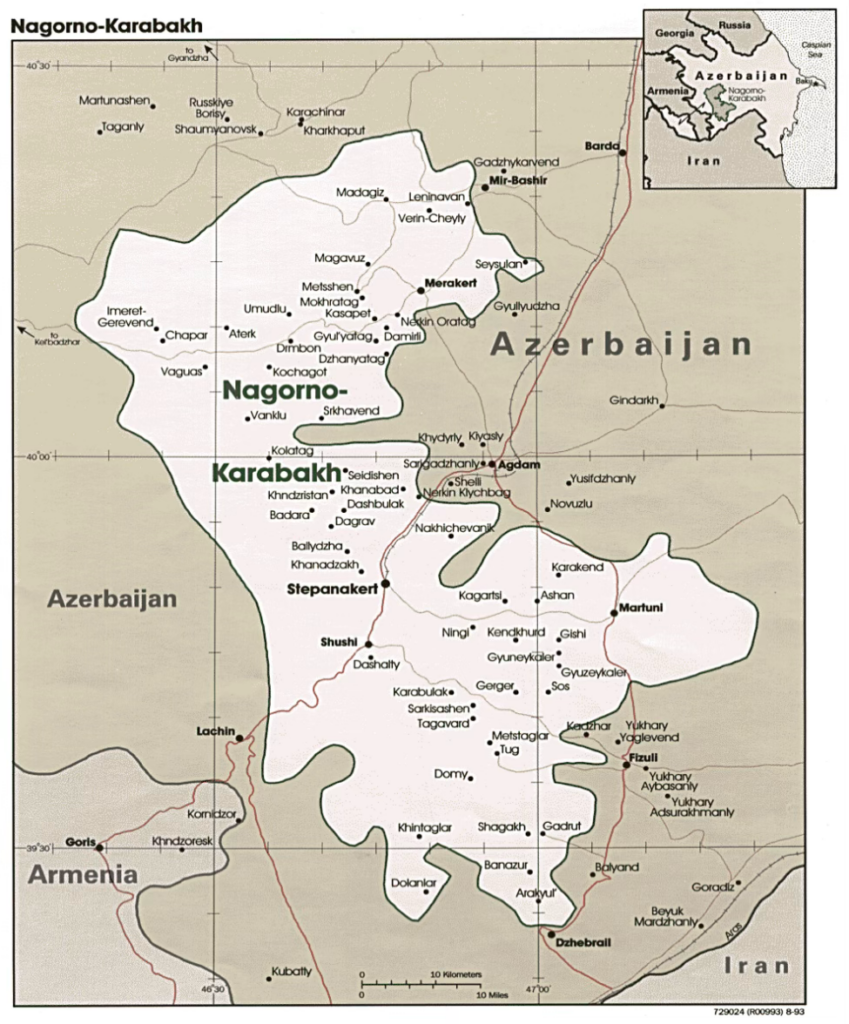
The conflict over Nagorno-Karabakh (Figure 1) is a complex issue. Alongside the overarching political and geopolitical dynamics, it encompasses disputed readings of history, understandings of geography and territory, and humanitarian, legal, social, and cultural facets. The Armenian presence in the Armenian Highlands (a mountainous area in what is today central and eastern Turkey) and the Caucasus can be traced back to antiquity, while Turkic populations from central and eastern Asia have established themselves for many centuries in the region. Both were, for the most part, subjects of various empires, sometimes with some degree of political or civil autonomy, depending on the specific time and place. After the dissolution of the Armenian Khachen principality in the 15th century, the Armenians of Artsakh established an autonomous region within the Persian Empire known as the Five Melikdoms of Karabakh which was ruled by Armenian nobles (meliks) until the annexation by the Russian Empire and the dissolution of the feudal system in 1822. The more immediate historical development of the Nagorno-Karabakh dispute can be divided into four periods, beginning with the establishment of the Soviet Union.
Sovietization and the Nagorno-Karabakh Autonomous Oblast – 1923-1988
The turn of the 20th century was tumultuous for the Armenian people. The majority of Armenians lived within the Ottoman Empire at the time. This was the period of the rise of Armenian and Turkish nationalism, nationalist liberation movements, and struggles for the independence of other peoples in the region. The Ottoman state frayed against such domestic upheavals, which often took place with the interventions of the Great Powers (Britain, France, Russia, Austria-Hungary, Germany, and Italy). One of the outcomes of this unstable context was the systematic discrimination against and targeted killings of the Armenians (and other Christian minorities) of the Ottoman Empire, in particular, the Hamidian Massacres of 1894-1896 and the Adana Massacres of 1909. The Armenian Genocide took place soon thereafter under the cover of the First World War.
A substantial proportion of the Armenian people also lived in the Romanov (Russian) Empire at the time. Nationalist movements had also sprung up there, notably in the Caucasus, a very diverse area inhabited by a few large populations – Armenians, Georgians, Azerbaijanis (historically referred to as Caucasian Tatars) – alongside several smaller communities. The region plunged into disorder after the February and October revolutions of 1917. Over the following years, the Allied Powers declared and recognized the independent states of Armenia, Georgia, and Azerbaijan. But the three never fully agreed on their borders with one another. Each pursued different centers of power to guarantee their security. The Armenian state was most vulnerable, especially having to care for an immense refugee population of genocide survivors. There were numerous episodes of small- and large-scale fighting across the region before the Bolsheviks, having won the civil war in Russia, reclaimed control over the region.
For the Bolshevik leaders in Moscow, managing the various regional conflicts was one of the challenges for establishing Soviet republics in the Caucasus and, soon thereafter, the Union of Soviet Socialist Republics. One of the approaches they adopted was the provision of local autonomy. The Soviet Union found its feet in the 1920s and organized its territorial administration along the lines of top-level union republics and lower-level autonomous units, variously called okrugs, krays, regions, republics, or oblasts. The designations and how political or legal power was distributed were not always consistent. Most consequentially, these administrative units were built around nationalities – ethno-national identities that could claim a territory as their own, even if not as a sovereign state. It is with some irony that the cosmopolitan, international communist revolution ended up facilitating nationalist ideology by creating national territorial spaces.
However, the administrative divisions across the Caucasus did not follow the distributions of national populations. Soviet Georgia ended up with substantial Armenian and Azerbaijani minorities, while local autonomy was established for Abkhazia, Adjara, and South Ossetia within it. Soviet Armenia had no local autonomous units, although it had a significant Azerbaijani minority. Soviet Azerbaijan had its own very large Armenian population. One of Soviet Azerbaijan’s local autonomous units was the Nakhichevan Autonomous Republic. The other was the Nagorno-Karabakh Autonomous Oblast (NKAO), with its capital Stepanakert (Figure 2). The NKAO had an Armenian majority population; its territory was carved out as a sort of kidney-shaped “island,” which, at its closest point, was separated from Soviet Armenia by only seven kilometers.
The ‘Karabakh Movement’ and the First Karabakh War – 1988-1994
On many occasions throughout the Soviet years, Armenians from the NKAO expressed their desire to become a part of Soviet Armenia, to no avail. It was only in the 1980s, with the liberalization of the Soviet regime – perestroika and glasnost under the leadership of Mikhail Gorbachev – that opportunities arose to pursue that objective more seriously. As an offshoot of an environmental protest, the ‘Karabakh Movement’ began in 1988, calling on the leadership in Yerevan, Baku, and Moscow to transfer Nagorno-Karabakh to Soviet Armenia. The movement and reactions to it from the Soviet Azerbaijani government led to sporadic violence. As the USSR collapsed in 1991, the clashes turned into a larger-scale war with the proclamation of the unrecognized Nagorno-Karabakh Republic (NKR), backed by the newly independent Armenia, against the newly independent Azerbaijan. The war took a heavy toll, with tens of thousands of casualties and hundreds of thousands of civilian Armenians and Azerbaijanis displaced from their homes in Armenia, Azerbaijan, and Nagorno-Karabakh and the areas surrounding it.

By the time of the cease-fire of 1994, the NKR had effective control over almost all of the former NKAO and, in whole or in part, seven surrounding districts of Azerbaijan, which created a space contiguous with Armenia. The strategic buffer zones came to be claimed by the unrecognized de facto independent country, which took on the name Artsakh, referring to an Armenian geographic designation for the region from antiquity.
“No War, No Peace” – 1994-2020
Over the following quarter of a century, though strongly supported by the Republic of Armenia as well as organized communities and individuals from the global Armenian Diaspora, the Nagorno-Karabakh Republic or Artsakh, either by itself or primarily through Armenia, tried to negotiate a settlement with an uncompromising Azerbaijan. The Minsk Group of the Organization for Security and Co-operation in Europe (OSCE) facilitated the peace process that was co-chaired by the United States, Russia, and France. Several meetings and summits took place in those decades as different geopolitical moments made their demands, indeed, informed by the interactions across Washington, Moscow, and Paris, as much as across Yerevan and Baku, as well as Stepanakert. The interests of other regional actors were also important factors – Turkey, which consistently backed its close ally Azerbaijan, and Iran, which maintained a neutral position, though often balancing in Armenia’s favor.
Clashes across the effective line of control or the border between Armenia and Azerbaijan escalated especially after 2014, the most significant episode being the Four-Day War of April 2016, as well as the fighting across the Tavoush-Tovuz provinces in north-eastern Armenia and north-western Azerbaijan in July 2020.
The Second Karabakh War and its Aftermath – 2020-Present
On September 27, 2020, Azerbaijani forces, backed by Turkish military advisors and matériel, with additional support from Israel, Pakistan, and mercenary fighters from Syria, engaged in a large-scale assault on positions held by the Nagorno-Karabakh Republic. The fighting was accompanied by shuttle diplomacy and negotiations mediated by the leaders of the United States (amidst a presidential election campaign), Russia, and France as the COVID-19 pandemic continued its spread across the globe. For six weeks, Azerbaijani troops pushed through. On the night of November 9-10, 2020, Russian President Vladimir Putin finalized a cease-fire arrangement with the president of Azerbaijan, Ilham Aliyev, and the prime minister of Armenia, Nikol Pashinyan. Among other things, it called for the withdrawal of Armenian personnel and the installation of Russian peacekeepers around the perimeter of what remained of the areas of the NKR still under the control of the unrecognized republic.
Nagorno-Karabakh held only one land connection with Armenia, known as the Berdzor or Lachin Corridor, surrounded by Azerbaijani forces and overseen by newly-arrived Russian troops. Moreover, as the winter turned into spring in 2021, Azerbaijan conducted incursions into Armenia proper, occupying territory that had never been disputed since Soviet times and also making claims to various parts of Armenia as historically Azerbaijani territory.
Starting December 12, 2022, Azerbaijani operatives began a blockade of the one road between Armenia and Nagorno-Karabakh, ostensibly as a protest by environmental activists. The Russian peacekeepers did not deter the action. It was followed by nine months of very limited supplies and movements across that highway and the development of a humanitarian catastrophe in what remained of Armenian-populated Nagorno-Karabakh: near-famine conditions, lack of electricity, water, natural gas, and medical emergencies. On September 19-20, 2023, Azerbaijani forces moved in for a final attack on Nagorno-Karabakh, framed as an “anti-terrorist” measure. The administration of the Nagorno-Karabakh Republic relented and even formally dissolved itself, after which the Berdzor Corridor was opened, and fuel was brought in. Over a hundred thousand Armenians fled in the days that followed in a process that has been variously characterized as ethnic cleansing or genocide, thus ending the Armenian population’s presence in Nagorno-Karabakh.It Is worth mentioning that after the expulsion of the Armenians, Azerbaijani soldiers started looting Armenian houses and posting pictures and videos of looted houses and properties on social media. Meanwhile, Baku has destroyed the National Assembly (Parliament) building in the capital Stepanakert under the pretext that it was constructed “illegally.”
International Reactions
International reactions and resolutions are important as the international community has a conventional obligation to ensure and guarantee the safe return of Armenians of Nagorno-Karabakh and protect their property from further destruction. This section will highlight key reactions from international organizations and states regarding the right of return of Armenians of Nagorno-Karabakh.
Statements from International Institutions
The International Court of Justice (ICJ) made important remarks regarding the ethnic cleansing process in Nagorno-Karabakh. On November 17, 2023, the ICJ published a decision mentioning that “the operation commenced by Azerbaijan in Nagorno-Karabakh on September 19, 2023 took place in the context of the long-standing exposure of the population of Nagorno-Karabakh to a situation of vulnerability and social precariousness.” The Court also, quoting UN reports, mentions that “there have also been hindrances to the importation into Nagorno-Karabakh of essential goods, causing shortages of food, medicine, and other life-saving medical supplies.”
On October 5, 2023, after a quadrilateral meeting between Armenia, France, Germany, and the EU, a statement was adopted regarding the right of return. The statement mentioned that refugees must be free to exercise their right of return without any preconditions and with international monitoring in order to respect their cultural and human rights. Six days later, dozens of countries joined France in a joint statement presented to the UN Human Rights Council calling on Azerbaijan to ensure the rights of Armenians of Nagorno-Karabakh and “create conditions for the voluntary, safe, dignified, and stable return of those who want to go home.” The President of the Council of EU and more than 30 European countries, including Armenia, signed this statement. UN officials also made similar statements. On October 2023, Alice Wairimu Nderitu, UN Special Adviser on Genocide Prevention, made a call to ensure the protection and human rights of Nagorno-Karabakh Armenians “remaining in the territory, as well as those who have left, including the right of return, which should be a priority” she added. Other UN officials such as Volker Türk and Maurice Tidbas-Binz made similar statements.
Moreover, on January 18, 2023, the European Parliament adopted the 2022 annual report of the general foreign and security policy, which mentioned that the rights and security of Armenians of Nagorno-Karabakh should be protected. On March 2023, the Parliament, when addressing EU-Armenia and EU-Azerbaijan relations, called for signing a mutually acceptable peace treaty that should also address the return of the internally displaced people and refugees and protect the cultural, religious, and historical heritage of Nagorno-Karabakh. On October 5, a few weeks after the exodus of Armenians from Nagorno-Karabakh, the European Parliament adopted a resolution stating, “Nagorno-Karabakh Armenians have the right to live in their homes in dignity and security.” Finally, on March 13, 2024, the Parliament adopted a new resolution calling on Azerbaijan “to genuinely engage in a comprehensive and transparent dialogue with the Karabakh Armenians to ensure respect for their rights and guarantee their security, including their right to return to and live in their homes in dignity and safety under international presence, to access their land and property rights, to maintain their distinct identity and fully enjoy their civic, cultural, social and religious rights.”
In parallel, similar statements were recalled by EU agencies and officials. On September 23, 2023, the European External Action Service and high representative of the EU foreign and security policy, Joseph Borrell, in a speech at the UNSC, mentioned that Azerbaijan has a responsibility to ensure the rights of Nagorno-Karabakh Armenians and called on Baku to engage in dialogue with the Nagorno-Karabakh Armenians to facilitate their dignified return and ensure their security and rights. Within this context, the spokesman of the European Commission on Foreign and Security Policy said that the property of the Armenians in Nagorno-Karabakh cannot be confiscated or resettled by someone else. It is also worth mentioning that the EU mission in Armenia made a similar statement and even went a step further by proposing a UN mission to enter the Armenian-populated areas of Nagorno-Karabakh.
Reactions from Key States
Interestingly, the major powers generally support the right of return for Artsakh Armenian refugees, but each interprets this right from its own unique perspective.
In a resolution in January 2024, the French Senate recalled the rights of peoples to self-determination of Armenians of Nagorno-Karabakh and demanded that Azerbaijan make every effort to return Armenian refugees “in conditions likely to ensure their safety and well-being.” This was very important as France has linked the self-determination of Armenians to the right of return. Meanwhile, in the US, the issue of the right of return has been addressed on many levels. US State Department spokesman Matthew Miller, on November 14, 2023, stated that the US continues to believe that Armenians of Nagorno-Karabakh have the right to return to their homes if they wish so, and this right should be respected.James C. O’Brien, Assistant Secretary of State for European and Eurasian Affairs, in a statement on November 15, 2023, mentioned: “We have urged Azerbaijan to ensure all ethnic Armenians who have departed Nagorno-Karabakh are guaranteed a safe, dignified, and sustainable return, should they so choose, with their rights and security guaranteed.” Finally, in April 2024, several U.S. Senators sent a letter to Secretary Blinken calling for the Biden administration to ensure the right of return: “Given the serious human rights violations perpetrated by Azerbaijan, we further urge you to label what took place in Nagorno-Karabakh in September 2023 as an ethnic cleansing and advocate for the right of Nagorno-Karabakh’s Armenians to return to their homes under international guarantees.” Within this context, Representative Brad Sherman of the House Foreign Affairs Committee has stated: “True justice is when [forcibly displaced Armenians] can return to their ancestral homes where they lived for a thousand and more years in Nagorno-Karabakh.” While Russia has made statements regarding the return of Armenian refugees to Nagorno-Karabakh, it has avoided framing the issue from the perspective of international law, specifically the “right of return.” Instead, Russia asserts that Armenians “voluntarily” left Nagorno-Karabakh and denies any claims of ethnic cleansing against them.
Despite the Russian position, it is clear that the international community overwhelmingly supports the right of the Armenian people of Nagorno-Karabakh to return. Armenian political thought needs to solidify ideas on how international guarantee mechanisms can ensure the right of return is realized in this scenario. Currently, the Armenian authorities are hesitant to bring up this matter, fearing that Azerbaijan may retaliate by also raising the issue of allowing Azerbaijanis to “return to Armenia.” Until Russian peacekeepers left Nagorno-Karabakh, they had their interests in the situation, viewing the return of some Nagorno-Karabakh Armenians as crucial to their continued presence. We believe that achieving lasting peace in the area requires the repatriation of Nagorno-Karabakh residents with international guarantees.
International Human Rights Law
The right of return is a legal principle that guarantees the right of displaced people and their descendants to return to their place of origin. The right has been codified in various international instruments. This section will analyze the scope of the right of return and its basis in international human rights law, customary international law, refugee law, international humanitarian law, international criminal law, and the laws of state responsibility.
Universal Declaration of Human Rights
The Universal Declaration of Human Rights (UDHR), adopted by the United Nations General Assembly in 1948, is the cornerstone of the right of return in international human rights law. While the UDHR does not carry legally binding force, it holds significant authority in international law and, over time, has come to be widely recognized as reflective of customary international law, embodying principles that influence and shape international human rights treaty frameworks globally.
Article 13 of the UDHR affirms the right of return in broad and straightforward terms: “Everyone has the right to leave any country, including his own, and to return to his country.”This provision emphasizes the intrinsic connection between an individual and their homeland, employing unconditional language to underscore its universality. Similar to other rights enshrined in the UDHR, the right of return is subject to a narrow set of limitations articulated in the Article.29 These restrictions are permissible only when established by law and aimed at safeguarding the rights of others or addressing considerations of “morality, public order, and the general welfare in a democratic society.”
International Covenant on Civil and Political Rights (ICCPR)
The International Covenant on Civil and Political Rights (ICCPR) codifies the right of return as a binding treaty obligation. Azerbaijan ratified the ICCPR in 1992 and, thus, is bound by its provisions, including the right of return. Article 12(4) of the ICCPR states, “No one shall be arbitrarily deprived of the right to enter his own country.”As one of the most significant international human rights treaties addressing the right of return, the ICCPR offers a comprehensive framework for understanding its contemporary application under international law.
Significantly, the ICCPR provides a broad interpretation of the applicability of the right of return, guaranteeing the right not only to those who have left their homeland but also to their descendants. By using the phrase “to enter” in Article 12(4) rather than “to return,” the ICCPR extends this right to individuals who may have never entered their “own country.” This interpretation is articulated by the Human Rights Committee, the monitoring body for the ICCPR, in General Comment 27, and is well-supported by the travaux préparatoires of the ICCPR.
Unlike other rights listed in Article 12 – such as the right to liberty of movement or the right to leave a country – the right of return under Article 12(4) is not subject to the derogation clauses in Article 12(3), which permits restrictions for purposes such as protecting national security or public order. As such, the right of return appears to carry a more absolute character than related rights in the same article. The right of return may only be constrained in specific narrowly construed circumstances that do not contravene the aims and principles of the ICCPR. The Human Rights Committee emphasized that this limitation applies to all forms of state action, whether legislative, administrative, or judicial. Even when interference with the right is authorized by law, it must be reasonable and justified in the specific circumstances. The Committee further noted that “few, if any, circumstances” exist in which the deprivation of the right to enter one’s country is reasonable. The travaux préparatoires clarify the limited scope of permissible restrictions, such as cases where exile is imposed as a penal sanction. This applies to states where legal systems permit judicial sentences of exile, allowing for limited interference with the right of return. Even in these cases, however, the interference must adhere strictly to the principles of due process.
Additional Human Rights Treaties
Several other international human rights instruments impart binding obligations on Azerbaijan regarding the right of return. For example, the Convention on the Elimination of All Forms of Racial Discrimination (CERD), ratified by Azerbaijan in 1996, affirms “[t]he right to leave any country, including one’s own, and to return to one’s country.” Likewise, the Convention on the Suppression and Punishment of the Crime of Apartheid (the Apartheid Convention), also ratified by Azerbaijan in 1996, incorporates similar protections. Article 2 of the Convention identifies inhuman acts that constitute apartheid, including denying a racial group basic human rights, including “the right to leave and return to their country.”
Regional Human Rights Instruments
Regional human rights instruments provide further guidance on the right of return. Azerbaijan ratified the European Convention on Human Rights (ECHR) in 2002. Article 3(2) of Protocol No. 4 to the ECHR states, “No one shall be deprived of the right to enter the territory of the state of which he is a national.” While the language of Protocol No. 4 to the ECHR is similar to that in Article 12(4) of the ICCPR, the Protocol narrows right holders to those holding the nationality of a territory or a state, unlike the ICCPR, which uses the broader terminology of one’s “own country.” Although Azerbaijan is not bound by other regional instruments, it is worth highlighting that incorporating the right of return into multiple regional systems underscores the universality of the norm. Article 22(5) of the American Convention on Human Rights (ACHR), Article 12(2) of the African Charter on Human and Peoples’ Rights, and Article 22 of the Arab Charter on Human Rightseach codifies a right of return.
Customary International Law
In addition to receiving broad protection under major international and regional human rights instruments, the right of return is also a principle embedded in customary international law. This right is grounded in widespread state practice, enabling most people to exercise it freely. The recognition of the right of return in international human rights law, its incorporation into many national constitutions and legal systems, and its consistent invocation in international humanitarian law and UN resolutions strengthen the argument that it forms part of customary international law. Some scholars even assert that the right of return has attained the status of a peremptory norm (jus cogens) in international law, meaning states cannot derogate it.
The right of return, as protected under international law, is inherently individual in nature. The fact that a person left their country as part of a mass displacement does not diminish their individual rights. Scholars emphasize that large-scale displacement does not invalidate the right of return, pointing to the consistent practice of United Nations organs advocating for the return of refugees and displaced persons following mass movements across borders. At the same time, when discussed in the context of mass movements, particularly of entire populations, the right of return often acquires a collective dimension. This collective aspect does not alter the fundamental nature of the right, which remains an individual right.
International Refugee Law
The right of return is also grounded in international refugee law, primarily governed by the 1951 Convention Relating to the Status of Refugees,as amended by the 1967 Protocol Relating to the Status of Refugees. Collectively referred to as the Refugee Convention, these instruments define the legal concept of a refugee and establish the rights and protections afforded to individuals who meet this definition. They also impose specific obligations on states that are parties to the Convention, including Azerbaijan, which ratified the Convention in 1993.
The Convention treats refugee status as a temporary condition that ends when a refugee resumes or gains meaningful national protection, including repatriation. Repatriation may be extended to refugees, regardless of whether they possess citizenship from the territory they fled. This is displayed in the Refugee Convention’s use of the phrase “left or outside which he remained,” a rather narrower reference to a refugee’s country of nationality.
While the Convention outlines safeguards afforded to refugees, the Office of the UN High Commissioner for Refugees (UNHCR) is tasked with the mandate of “facilitat[ing] the voluntary repatriation of such refugees,” among other undertakings. The UNHCR has identified three solutions for refugees – repatriation, host country integration, and third-state resettlement – but voluntary repatriation is the preferred tactic to address the displacement of refugees. The former High Commissioner for Refugees reinforced this point by stating, “The ultimate objective of the international protection of refugees is not to institutionalize exile, but to achieve solutions to refugee problems. Voluntary repatriation, whenever possible, is the ideal solution. [This is why]…I have stressed the refugees’ right to return home safely and in dignity.”
Over the past three decades, 30 million refugees have returned to the locations from which they were displaced. Programs of voluntary repatriation of refugees and displaced persons to their “place of origin” or “country of origin” have been carried out in Afghanistan, Bosnia, Croatia, Burundi, Guatemala, Liberia, and Mozambique, among other countries. These policies, whether the result of bilateral or multilateral accords or UNHCR initiatives, have been supported by the international community and reaffirm the right of return.
International Humanitarian Law
The right of return is further established in international humanitarian law, with the Hague and the Geneva Conventions providing the basic framework for the right. The 1907 Hague Regulations, annexed to the Hague Conventions, are universally recognized as customary international law. Similarly, many of the provisions of the Geneva Conventions have attained the status of customary international law, thus imposing a universal obligation on all states engaged in armed conflict to allow displaced individuals to return to their homes once hostilities have ended.
A general right of return is derived from Article 43 of the Hague Regulations. Article 43 states, “The authority of the legitimate power having actually passed into the hands of the occupant, the latter shall take all steps in his power to re-establish and ensure, as far as possible, public order and safety, while respecting, unless absolutely prevented, the laws in force in the country.”Though this provision does not explicitly discuss a right of return, it obliges occupying powers to restore normalcy and public order while respecting local laws, implicitly supporting the right of displaced persons to return to their homes following hostilities.
The Fourth Geneva Convention is more explicit, directly prohibiting the forcible displacement of individuals or groups and outlining repatriation obligations. Article 49 states, “Individual or mass forcible transfers, as well as deportations of protected persons from occupied territory to the territory of the Occupying Power or to that of any other country, occupied or not, are prohibited, regardless of their motive.” Article 147 reinforces Article 49, identifying “deportation and forcible transfer” as grave breaches of international humanitarian law, requiring states to prosecute such acts as war crimes.
Additional Protocols to the Geneva Conventions further support the prohibition against forcible expulsion and the corresponding right of return. Article 85(4)(a) of Additional Protocol I, which covers the protection of civilians in international war or conflict, asserts that “the deportation or transfer of all or parts of the population of the occupied territory within or outside this territory, in violation of Article 49 of the Fourth [Geneva] Convention” constitutes a grave breach of the Protocol. Article 17 of Protocol II, which applies in the context of non-international armed conflicts, also explicitly bans forced displacement and mandates that evacuated persons must be allowed to return home.
In instances where people have been temporarily evacuated, Article 49 of the Fourth Geneva Convention underscores that displaced individuals must be returned to their homes immediately after the cessation of hostilities:
Individual or mass forcible transfers, as well as deportations of protected persons from occupied territory to the territory of the Occupying Power or to that of any other country, occupied or not, are prohibited, regardless of their motive. Persons thus evacuated shall be transferred back to their homes as soon as hostilities in the area in question have ceased.
Furthermore, Article 45 categorically requires that displaced individuals, if transferred to the care of another state, must be repatriated after hostilities end.
International Criminal Law
Although international criminal law attributes responsibility to individuals instead of states, it nonetheless provides guidance on the issues of forced displacement and right of return. The Rome Statute, to which Armenia, but not Azerbaijan, is a party, defines the core framework and jurisdiction of the International Criminal Court (ICC). The statute extends the jurisdiction of the court to investigate, prosecute, and try those responsible for crimes in the territory of State Parties, meaning that perpetrators from Azerbaijan can be held accountable for violations that they carry out in Armenian territory, including the forced displacement of people from Nagorno-Karabakh into Armenia.
The Rome Statute recognizes unlawful forced displacement of civilians as part of three major crime categories: genocide, war crimes, and crimes against humanity. Article 6(e) states that the crimes of genocide may be established when “[f]orcibly transferring children of the group to another group” is “committed with intent to destroy, in whole or in part, a national, ethnical, racial or religious group.” Similarly, Article 8(2)(a)(vii) states that “[u]nlawful deportation or transfer” can constitute a war crime. The Statute clarifies that forced transfer can be a war crime in international and non-international armed conflicts.
Forced displacement may also constitute a crime against humanity. Article 7(1)(d) of the Rome Statute states that “[d]eportation or forcible transfer of the population,” when carried out “as part of a widespread or systematic attack directed against any civilian population, with knowledge of the attack,” is a crime against humanity. The Statute clarifies this offense in Article 7(2)(d), defining deportation or forcible transfer as “The forced displacement of the persons concerned by expulsion or other coercive acts from the area in which they are lawfully present, without grounds permitted under international law.”
State Responsibility for Internationally Wrongful Acts
A state commits an internationally wrongful act when it breaches an international obligation. This principle of international law underscores the accountability of states for actions that infringe on the rights or obligations owed to other states or individuals. When displacement becomes protracted, it may constitute an internationally wrongful act, particularly when the right of return is not implemented. Protracted displacement reflects a continued breach of international obligations, especially when states fail to present conditions that enable displaced populations to return home safely and voluntarily. The wrongful conduct lies in the persistent denial of the right of return, a recognized human right under international law, and forms part of the broader framework of state obligations.
Mass exile as an internationally wrongful act triggers a range of obligations aimed at remedying the harm and preventing recurrence. The responsible state must first cease its illegal actions, including refraining from obstructing displaced individuals’ return. This means that for those in extended displacement, the state must not prevent or reject their repatriation. The responsible state may be required to reform laws and institutions to deter future occurrences, ensuring that similar violations cannot happen again. This contributes to both prevention and deterrence efforts. The state must also aim to eradicate all consequences of its illegal actions and restore conditions to what they would have been if the violations had not occurred.
When mass displacement is an internationally wrongful act, it also activates an obligation to make reparation, encompassing restitution and compensation. Full restitution compels mass return, or the voluntary repatriation of all those displaced, offering displaced individuals the opportunity to reoccupy their homes rather than merely returning to their country of origin. This approach underscores the importance of restoring displaced persons to their original living conditions and communities.
The return of displaced people must be safe. Physical safety entails creating a secure environment free from threats such as attacks, harassment, or other forms of violence. Legal safety requires protecting individuals from discrimination in the enjoyment of their civil, economic, social, political, and cultural rights. Material safety, particularly in the early stages of repatriation, involves providing access to humanitarian aid and essential services, such as shelter, healthcare, food, and clean water.
The return of those who have been displaced must also be just. A just return encompasses fundamental principles of security and respect for human rights, ensuring that displaced individuals can repatriate under conditions that restore their sense of dignity and justice. Displaced individuals must actively participate in decision-making processes at every repatriation stage – before, during, and after their return.This includes recognizing cultural sensitivities and aligning with the needs and values of affected communities. Accountability requires reparations from the state, including the return of homes, land, and cultural artifacts, alongside mechanisms such as investigations, trials, truth-seeking processes, and formal apologies. By addressing these components – security, dignity, and redress – a just return ensures that repatriation is not merely a logistical process but a meaningful restoration of displaced individuals’ rights, dignity, and opportunities for reconciliation.
A right to fair compensation for property loss and damage is integral to the concept of just return. States bear a duty to provide compensation for personal property that was looted or destroyed during displacement, as well as for physical and mental suffering endured in exile, which may include prolonged psychological harm. Compensation for mental harm is particularly important, as extended displacement is often experienced as a form of systematic cruelty and humiliation by those affected. When full restitution is not feasible, compensation may serve as a substitute.
Recommendations
- We have seen that several international human rights instruments impart binding obligations on Azerbaijan regarding the right of return of Armenians of Artsakh/Nagorno-Karabakh. Although Baku claims that it has no problem in hosting the Armenians, its policies towards the Armenians of the region over the years have shown that without any international mechanism, presence, and guarantees, Armenians will once again face persecution. Therefore, the US and the international community must back the Armenian government to support the right of return of Armenians of Nagorno-Karabakh with international guarantees and mechanisms. Meanwhile, the United States government should take the necessary measures to encourage and convince Azerbaijan to create an environment for the secure and voluntary repatriation of forcefully displaced Armenians to their original homes, ensuring their safety and providing assurances against any racial, religious, or political discrimination, and ensure that the Armenian community’s voice is acknowledged and their rights protected.
- Since 2021, ACLED (Armed Conflict Location and Location Data) has recorded dozens of Armenian historical, cultural, and religious sites have been destroyed by Azerbaijan. Many fear that Nagorno-Karabakh may follow the fate of Nakhichevan, where in 2001, Azerbaijan finalized the iconoclasm of the Armenian presence by destroying centuries-old monasteries, cemeteries, and UNESCO-protected cross-stones (known in Armenian as Khachkars). The return of ethnic Armenians back to their homeland without preserving their cultural and religious presence (monuments, buildings, churches, and monasteries) will question the very existence of Armenian history on these territories. Hence, the United States government must press Azerbaijan to maintain international standards for cultural preservation and avoid any additional destruction or alteration of Armenian cultural sites. The Armenian and US governments should engage with the UNESCO and other pertinent organizations to enable impartial monitoring missions and encourage global discussions to safeguard and rehabilitate these locations.
Irrespective of the ongoing negotiations between Yerevan and Baku – often alongside the harsh rhetoric and increasing demands for concessions by top Azerbaijani officials against Armenia – the United States government must promote and back international legal initiatives to hold accountable those in Azerbaijan responsible for crimes against humanity and war crimes against the Armenians of Artsakh/Nagorno-Karabakh. The imposition of economic and other sanctions on Azerbaijan could be among the policies pursued. This kind of activity could help create the environment to prevent Baku from engaging in new hostilities against Armenia and promote the right of return of Armenians with security guarantees. Moreover, such a policy is helpful in creating a lasting peace in the South Caucasus and becoming a positive example for future conflict resolution cases.