
Hrayr Aghavelyan, JD
Ruben Melikyan, JD
Elisenda Calvet-Martínez, PhD
Abstract
This report examines the alarming escalation of police brutality in Armenia since 2023, highlighting its impact on civil liberties, democratic governance, and social cohesion. It documents patterns of excessive force, arbitrary arrests, and intimidation targeting peaceful demonstrators, journalists, clergy, and political opponents. These practices reflect a broader trend of politicized law enforcement and the militarization of police units, including operations within sensitive civic and religious spaces.
The findings highlight systemic deficiencies: the absence of independent oversight, weak accountability mechanisms, and political interference in policing. These failures have eroded public trust and undermined Armenia’s obligations under international human rights frameworks.
The report sets out a clear roadmap for reform aimed at restoring the rule of law and ensuring rights-respecting policing. Recommendations include: establishing an independent civilian oversight body with investigatory and disciplinary powers; demilitarizing law enforcement units deployed for crowd control; integrating comprehensive human rights training into police education; and enacting legislative reforms to strengthen judicial independence and prevent political abuse of security forces. In addition, the report calls for international engagement to provide technical assistance, monitor progress, and support the establishment of safeguards against recurrence of abuses.
Timely implementation of these measures is critical to reversing democratic backsliding, protecting fundamental freedoms, and building resilient institutions capable of upholding the rights of all citizens.
Introduction
Police Violence in Armenia: A Deepening Crisis
Police brutality in Armenia is not a new phenomenon. Successive administrations have repeatedly used law enforcement as a tool for political control, violating citizens’ fundamental rights to freedom of assembly, expression, and bodily integrity. However, while the country has a documented history of excessive force, the current period reflects a grave and unprecedented escalation—both in scale and in nature.
In June 2015, peaceful public protests erupted in response to a planned electricity tariff increase. Demonstrators gathered in Yerevan’s central Baghramyan Avenue in a nonviolent sit-in. Police responded with disproportionate force, deploying high-pressure water cannons at close range and physically assaulting protesters—including those far from the protest site. Reports indicated that plainclothes officers, led by high-ranking officials, carried out coordinated attacks. Over 230 people were detained, including journalists, women, minors, and human rights observers—many of whom were denied legal counsel and medical care. Although the Chief of Police later issued a public apology and several officers were reprimanded, human rights organizations dismissed these measures as cosmetic, failing to address systemic abuse or ensure accountability.
A year later, in July 2016, an armed opposition group known as Sasna Tsrer seized a police station in Yerevan and held hostages, demanding political change. The incident triggered large-scale public demonstrations across the country. Once again, police responded not with restraint or proportionality, but with widespread violations of human rights. Peaceful demonstrators were met with violence, arbitrary arrests, and targeted attacks on journalists. The most egregious crackdown occurred on the night of July 29, when police forces used stun grenades and batons to disperse crowds. Although some officers faced disciplinary action, the lack of transparent investigations and meaningful sanctions underscored the culture of impunity.
These prior incidents reveal a pattern of abusive policing, enabled by institutional weaknesses, limited judicial independence, and political interference. Yet, when compared to the current cycle of repression, they now appear constrained in both visibility and intent.
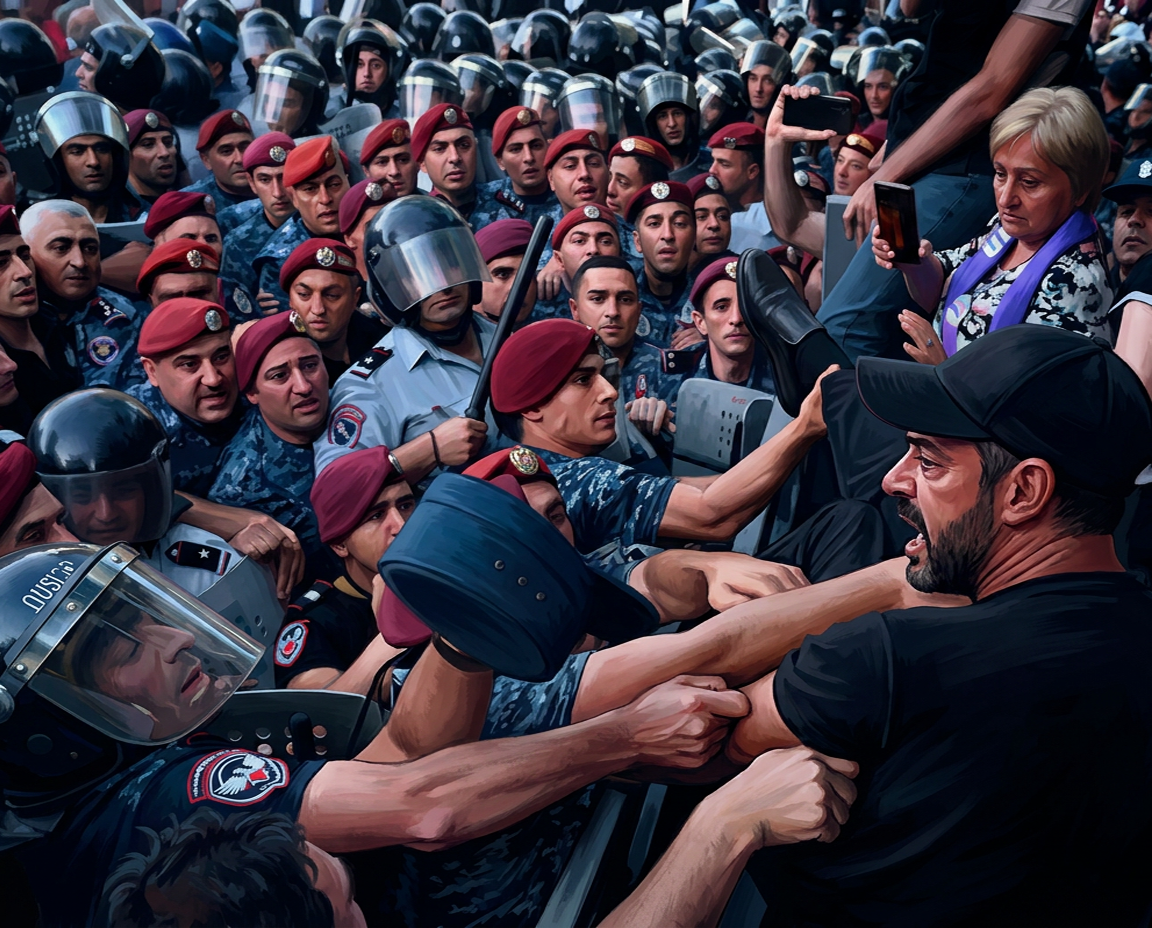
Today, Armenia faces a far more alarming deterioration. Police operations have become openly politicized, systematically violent, and deeply dehumanizing. The deployment of elite tactical units, mass arbitrary arrests, the suppression of protests through brute force, and the outright invasion of sacred spaces such as the Mother See of Holy Etchmiadzin mark a new and disturbing departure from past precedent. Never before in the Republic of Armenia’s history have law enforcement bodies stormed the symbolic center of the Armenian Apostolic Church—a move widely condemned as an attack not only on religious sanctity, but on national identity.
This evolution is not simply a matter of degree—it is a transformation of character. While past abuses, though severe, operated within at least a nominal framework of legality and procedural restraint, today’s actions demonstrate a willingness to dismantle those safeguards entirely. The law enforcement apparatus has become a weapon of political retribution, used to silence dissent, intimidate civil society, and dismantle democratic accountability.
In light of this, it is critical to emphasize that the issue of police violence in Armenia must be viewed not as isolated incidents, but as part of an increasingly institutionalized pattern. The shift from ad hoc abuses to a sustained campaign of political policing represents a profound threat to human rights, democratic governance, and the rule of law. International actors, civil society, and legal institutions must respond with urgency to prevent further erosion of Armenia’s constitutional order and to demand justice for victims of unlawful state violence.
This report addresses the anti-government protests that took place in Armenia in September 2023 and 2024 and the cases of disproportionate use of force by the police during them. Public discontent has increased in recent years, due to both the domestic political crisis and international developments. Protests in various cities, which were mainly directed against government policies, were accompanied by mass arrests, the widespread use of special measures, the use of disproportionate force by the police against peaceful protesters, as well as serious human rights violations.
The report also details the unlawful actions recorded by the police, including the use of disproportionate force, the unjustified use of stun grenades and tear gas, and the brutal arrests of peaceful protesters, as well as the responses of human rights organizations. These actions by the police clearly constitute violations of human rights, including the right to peaceful assembly, freedom of expression, and the right not to be subjected to ill-treatment. These rights are protected under international treaties to which Armenia is a party and is obligated to uphold. The report is based on various sources, witness testimonies, and media reports, with the aim of documenting these violations and demanding accountability.
International Human Rights Framework
The use of excessive and disproportionate force by Armenian police during peaceful protests in Armenia in 2023 and 2024 must be evaluated within the context of international human rights law. Armenia is a party to several key international treaties that establish clear obligations regarding the protection of civil rights and the use of force by state agents.
The Right of Peaceful Assembly and Freedom of Expression
The 1948 Universal Declaration of Human Rights recognizes the right to freedom of peaceful assembly and association (article 20) and the right to freedom of opinion and expression (article 19). Under the International Covenant on Civil and Political Rights (ICCPR), to which Armenia is a State Party since 1993, individuals have the right to peaceful assembly (Article 21) and freedom of expression (Article 19). These rights are also enshrined in the European Convention on Human Rights (ECHR), ratified by Armenia in 2022, particularly Articles 10 and 11. Any restriction on these rights must be lawful, necessary, and proportionate. At the domestic level, the 1995 Constitution of Armenia recognizes the freedom of assembly in conformity with the ICCPR and the ECHR.
The right to peaceful assembly is a fundamental human right which allows individuals to express themselves collectively in support of or opposition to ideas that are essential for the progress of society. The UN Human Rights Committee defines the freedom of assembly as the “foundation of a system of participatory governance based on democracy, human rights, the rule of law and pluralism”. The failure to protect the exercise of this right by the State authorities is often considered a sign of repression inacceptable in a democracy. According to international human rights law, the limitations to the right of peaceful assembly have to be provided by law, pursue a legitimate aim, and be necessary in a democratic society in the interests of national security or public safety, for the prevention of disorder or crime.
Use of Force by the Police Agents
The UN Basic Principles on the Use of Force and Firearms by Law Enforcement Officials, adopted in 1990, specify that force must only be used when strictly necessary and to the extent required for the performance of duty. Principle 13 provides that “In the dispersal of assemblies that are unlawful but non-violent, law enforcement officials shall avoid the use of force or, where that is not practicable, shall restrict such force to the minimum extent necessary”. Therefore, the use of excessive or indiscriminate force, especially against peaceful demonstrators, constitutes a violation of these principles. In 2020, the UN adopted the Human Rights Guidance on Less-Lethal Weapons in Law Enforcement to assist States on how to use less-lethal weapons according to international human rights law.
Use of Tear Gas
Although tear gas is not listed as a toxic gas in the annex of the Chemical Weapons Convention (CWC), its use is still subject to international legal. The use of this gas may produce side-effects such as “respiratory problems, nausea, vomiting, irritation of the respiratory tract, irritation of the tear ducts and eyes, spasms, thoracic pain, dermatitis or allergies.” The CWC, ratified by Armenia in 1995, explicitly prohibits the use of riot control agents (RCAs) such as tear gas “as a method of warfare” (Article I(5)), but permits the use of RCAs for law enforcement purposes, including crowd control and breaking up protests (Article II (9) (d)). However, such use must comply with international human rights standards, particularly those concerning necessity, proportionality, and the protection of physical integrity.
The Use of Stun Grandes by State Agents
Stun grenades are not explicitly regulated under international arms control treaties such as the CWC. However, their use by law enforcement is subject to international human rights law. According to the UN Basic Principles on the Use of Force and Firearms by Law Enforcement Officials, any use of force must be necessary, proportionate, and aimed at minimizing harm. When deployed inappropriately—such as in confined spaces, against peaceful protesters, or without prior warning—stun grenades can cause serious injuries and may amount to cruel, inhuman, or degrading treatment. Although not banned, their use must be carefully supervised to guarantee compliance with State obligations under the ICCPR, CAT, and ECHR. The lack of specific international regulation has led to growing calls for clearer global standards on the use of less-lethal weapons, including stun grenades, especially when used in combination with RCAs like tear gas.
Right Not to be Subjected to Ill-treatment
The prohibition of torture or cruel, inhuman or degrading treatment or punishment is recognized in numerous international human rights instruments such as the UDHR (article 5), the ICCPR (article 7), and the ECHR (article 3). Additionally, the Convention against Torture and Other Cruel, Inhuman or Degrading Treatment or Punishment (CAT), adopted in 1984 and ratified in 1993, aims to prevent and punish acts of ill-treatment. It obliges State Parties to codify the crime of torture, investigate and prosecute the perpetrators, and provide redress for the victims. Since 2002, Armenia has been a member of the Council of Europe anti-torture Committee (CPT), which aims at assisting countries to ensure that no person deprived of his/her liberty is subjected to torture or inhuman or degrading treatment. However, the CPT does not have investigative powers. Moreover, in international law, the prohibition of torture is a peremptory norm, which means it cannot be derogated under any circumstances by the State. At the domestic level, article 26 of the 1995 Armenian Constitution established that “no one may be subjected to torture, inhuman or degrading treatment or punishment”.
The violation of Article 3 of the ECHR, which recognizes the right not to be subjected to ill-treatment, can be of a substantive or procedural nature. The excessive use of force against peaceful demonstrations can constitute a degrading treatment and a violation of Article 3 of the ECHR in its substantive dimension if the use of force can be considered as unnecessary for the prevention of the disorder. In addition, the failure of the authorities to conduct an effective investigation into the disproportionate use of force to dismantle a peaceful demonstration can constitute a procedural violation of Article 3 of the ECHR.
Armenia’s Police Force Today
The Expansion and Militarization of Armenia’s Internal Security Apparatus: U.S. Support and Implications
Armenia, a nation of approximately 2.8 million people, maintains an outsized and increasingly sophisticated internal security structure. Official estimates suggest a police force of around 13,500 personnel, with additional paramilitary and special forces formations under various agencies such as the Police Troops and the National Security Service (NSS). Despite ranking 9th globally on the 2025 Numbeo Safety Index for low crime and public disorder, Armenia’s internal security forces have grown in size, tactical readiness, and operational scope in recent years — a trend that has paralleled substantial international funding and training programs, particularly from the United States.
Since 2020, the United States Agency for International Development (USAID) and other U.S. entities have provided Armenia with multi-year support programs, officially framed around democratization, transparency, and law enforcement reform. However, on-the-ground developments reveal a concerning trajectory of police militarization, crowd control specialization, and aggressive use of force, especially during peaceful protests and public dissent.
Elite Security Units and Their Deployment
Armenia’s internal security apparatus includes several high-readiness special forces units, which are typically reserved for counterterrorism operations or high-risk law enforcement actions. However, their repeated and aggressive deployment in recent civic demonstrations — particularly around religious institutions — has raised serious concerns about proportionality, civilian targeting, and political overreach. The following are the key units reportedly involved:
- Alpha Unit of the National Security Service (NSS “A” Directorate): This is Armenia’s most elite counterterrorism force, trained for rapid response to critical threats. The Alpha Unit is typically reserved for operations involving national security risks but has recently been seen deployed in politically sensitive contexts, including religious and civil protests.
- “Black Panthers” Special Forces Unit of the Police: The highest-readiness tactical unit within the general police force. Their involvement is usually associated with high-risk criminal apprehension but has expanded into crowd control and protest dispersal operations, signaling a militarized approach to public demonstrations.
- Special Forces Battalion (“Red Berets”) of the Police Troops: This unit is Armenia’s most visible internal troop force, often utilized in public order enforcement. Their deployment has become increasingly frequent during large-scale protests and religious gatherings, contributing to intimidation and escalation of tension.
- Special Company (“Black Berets”) of the Police Troops: Functioning as a rapid intervention unit within the broader police troop structure, the “Black Berets” are often employed in preemptive raids or high-impact security operations, including controversial entries into sacred religious spaces.
These units, although nominally law enforcement bodies, operate with militarized tactics and equipment, often contradicting the UN Basic Principles on the Use of Force and Firearms by Law Enforcement Officials, which mandate restraint, proportionality, and protection of human life.
According to multiple independent observers and civil society organizations, a very large number of law enforcement personnel were mobilized across different locations in recent weeks — an extraordinarily high number for a country of Armenia’s population size. This disproportionate deployment not only reflects an excessive use of force but also points to a worrying trend of authoritarian-style policing, particularly in response to peaceful assemblies and dissent.
U.S. Funding and Strategic Training Initiatives
The United States has invested approximately $3.3 billion in Armenia since 1992, aimed at democratic development, economic growth, and humanitarian support. Within that, a significant portion has gone toward security sector reform:
- $27 million allocated for border security in partnership with the Export Control and Border Security Program and U.S. Customs and Border Protection.
- $16 million directed to develop Armenia’s patrol police, which was originally envisioned as a model for civilian policing.
- An additional $20.6 million in recent U.S. commitments includes law enforcement modernization, community safety, and justice sector reform.
U.S. assistance is also directed toward community policing microgrants, aimed at strengthening police-public relations, and institutional reform programs to establish civilian oversight mechanisms.
Training Programs and Tactical Upgrades
The U.S. has sponsored extensive training for Armenian law enforcement officers, facilitated through agencies such as the International Criminal Investigative Training Assistance Program (ICITAP) and the International Association of Chiefs of Police (IACP). Notable training initiatives include:
- Scenario-based tactical response and crowd control operations
- Community policing methodologies aimed at enhancing engagement and accountability
- Training in leadership, ethics, adult education techniques, and problem-solving
- Specialized English-language courses for international coordination and public relations
- Interoperability preparation with NATO standards, including border security and WMD nonproliferation strategies
- Assistance in establishing a new civilian ministry to supervise and reform police institutions
While these programs are framed around modernizing Armenia’s law enforcement, concerns have arisen regarding their real-world impact, particularly when highly trained units and Western-supplied equipment are deployed not to combat crime but to suppress dissent and peaceful assembly.
Legal and Ethical Concerns
The application of force by Armenian law enforcement in recent years — particularly during the 2023–2025 anti-government protests — has raised serious questions regarding the misuse of foreign-trained security personnel and a lack of adequate safeguards. International legal instruments, such as the UN Basic Principles on the Use of Force, require that law enforcement:
- Use force only when strictly necessary
- Employ non-violent means first
- Act with proportionality and restraint
- Ensure immediate medical aid for the injured
- Report and independently review incidents of violence
However, numerous documented violations during protest suppression operations suggest systemic gaps in oversight, accountability, and political neutrality.
Abuse of Power by the Police During the Events of September 2023
In September 2023, when Azerbaijani forces launched a large-scale offensive against the Republic of Artsakh, distrust of the Armenian authorities grew among Armenian society. The fate of tens of thousands of citizens displaced from Artsakh, as well as the Armenian government’s response during the war, led to mass rallies. During protests in Yerevan and other cities in September-November, the police used particularly brutal force and mass arrests.
We will present the incidents of the September 2023 peaceful demonstrations and police misconduct in order:
Thus, on September 21, the police, without prior warning, used brute force to administratively arrest members of the Resistance Movement (anti-government demonstrations from April to June demanding Prime Minister Nikol Pashinyan’s resignation over his handling of the ceasefire after the 2020 Nagorno-Karabakh war), including Suren Sahakyan and Mikayel Nahapetyan, from Mashtots Park. The latter were not carrying out any action; they did not even have time to open the tent when the police officers detained them. And on September 22, more than 110 protesters were arrested on different streets of Yerevan. . According to eyewitnesses and those who were detained, the police were hitting, beating, cursing, and degrading the protesters while they were being taken to the police stations. While detaining Levon Kocharyan from Amiryan Street in Yerevan, the police brutally beat him and inflicted various bodily injuries in the police car. The latter’s lawyer noted that Levon Kocharyan was hospitalized by ambulance. A motion to arrest four red berets has been filed within the framework of the criminal proceedings against Levon Kocharyan for torturing him.
Several dozen participants are being prosecuted politically and criminally, the sole purpose of which is to keep the citizens of the Republic of Armenia away from participating in similar peaceful disobedience actions and rallies held in the capital and various cities of the Republic. Almost all of the arrested persons were subjected to severe beatings and torture by the officers of the Internal Affairs Police Division of the Ministry of Internal Affairs, both at the time of arrest and on the way to the relevant police departments, which was accompanied by sexual insults and threats that insulted the honor and dignity of these persons.
We also note that neither the Ministry of Internal Affairs Police nor the RA Investigative Committee is implementing any legal equivalent process regarding these criminal violence cases in front of the public and cameras, encouraging such criminal behavior by specific police units.
On September 25, journalist Davit Sargsyan, former chairman of the Yerevan State University Student Council, Tsolak Akopyan, and Armen Khachikyan were detained in front of the rector’s office of Yerevan State University. According to the video released by the National Committee, the latter talked to the media when the red berets entered the area and detained them.
It should be noted that NA deputy Tadevos Avetisyan was also detained. According to his lawyer, he has been arrested.
Abuse of Power by the Police During the Events of April-June 2024
Background
Several factors caused the anti-government protests in Armenia in 2024, the main ones being:
- Territorial concessions and demarcation process. As part of the demarcation process with Azerbaijan in the Tavush region, some territories of Armenia were unilaterally ceded to Azerbaijan without legal justification and adequate compensation. This process was carried out secretly, without public discussion, which caused large-scale protests and public indignation. Citizens, opposition forces, and expert circles condemned this step, considering it unacceptable from the point of view of national interests.
- Foreign policy failures. The Armenian authorities’ disproportionate concessions, lack of diplomatic initiatives, and failure to ensure proper protection of national interests in international forums led to the country’s political isolation. In the negotiation process with Azerbaijan and Turkey, the Armenian leadership mainly made unilateral concessions, which caused distrust and widespread dissatisfaction among the public.
Due to these and other factors, large-scale protests have occurred in Yerevan and other cities of Armenia since the spring of 2024. The police responded to the demonstrators with harsh and sometimes illegal methods; mass arrests were carried out, and special measures were used, including stun grenades and tear gas. In several cases, the actions of the police openly contradicted both the Constitution of Armenia and the norms of international law. The excessive or indiscriminate use of tear gas raises serious concerns. When deployed against non-violent demonstrators, tear gas may constitute a form of ill-treatment, especially if used in confined spaces or in a manner that causes unnecessary harm. This could potentially violate Armenia’s obligations under the Convention against Torture, the International Covenant on Civil and Political Rights, and the European Convention on Human Rights, which protect individuals from cruel, inhuman, or degrading treatment.
Events in the Tavush Region (April-May, 2024)
During the protests on the Voskepar-Kirants road in Tavush region and in the city of Noyemberyan since April 21, the number of people arrested has reached 11, and 1 more person has been charged. Often, disproportionate and brute force was used against the protesters to open the roads that the protesters had blocked as a sign of protest and disagreement with the demarcation process. The protesters were beaten, received various bodily injuries and blows, and were subjected to discriminatory treatment and brutal beatings while being transported to police stations and in the stations themselves.
On April 26, 2024, protesters blocked the Kirants-Voskepar road; the police tried to open the road, involving many black berets, a special Armenian police unit. Clashes and fights took place. The situation got out of control . The videos clearly show how the black berets beat, dragged, and used disproportionate force against protesters who did not provoke the situation but raised their voices of protest against the ongoing processes.
On April 26, 17 people were arrested and taken to various police departments during protests in different parts of the Republic. The citizens were detained on suspicion of violating Article 182 of the Code of Administrative Offenses (Failure to comply with a lawful request of a police officer),.
On April 27, a group of police officers operating near the Hrazdan section of the Yerevan-Sevan highway, without presenting any legal basis or official demands, escalated tensions and used physical force against opposition MP Artur Khachatryan, a member of the “Armenia” parliamentary faction. He was violently detained and transported by four officers in a police vehicle to the Hrazdan police station in the Kotayk region. The actions appeared arbitrary and excessive, with no clear legal justification, raising concerns about the political motivation behind the arrest and the broader targeting of opposition figures. The video clearly shows how Ruben Davtyan, the head of the Kotayk regional department of the RA Police, incites, provokes, and tenses the situation, after which an argument and a scuffle begin, and the police officers beat and detain the deputy :
On May 2, early in the morning at around 6:00 AM, the Police used unlawful force against residents of Kirantsi who were blocking the Armenia-Georgia interstate highway and obstructing the so-called “demining works” in the Kirantsi section. About three dozen citizens were brought to the Ijevan Police Department with the use of disproportionate force. Among those arrested were also minors .
According to villagers, the police used force against citizens. Various individuals reported that they were subjected to violence during their arrest, such as hair pulling, hitting, or being reminded of previous incidents. No serious injuries were reported among those injured, but some citizens reported shoulder or leg pain.
The Ministry of Internal Affairs denied using force and noted that no special operation was conducted against the detained citizens. However, a police representative, who introduced himself as Colonel Khachatryan, told RFE/RL that special operations were being carried out.
In turn, the Ministry of Internal Affairs clarified that the Ministry of Defense is conducting demining work in the border zone, which is why citizens’ access to the area has been restricted to ensure their safety.
Human rights activist Artur Sakunts assessed the police actions as violating the freedom of peaceful assembly. He noted that even if individuals violated the principles of peaceful assembly, only they should have been detained, and that legally and reasonably. According to him, recently, the police have been violating both the legislation of the Republic of Armenia and the European Convention.
Sakunts also emphasized that the police should use physical force in exceptional cases, giving a warning and giving citizens a reasonable amount of time. However, according to eyewitnesses to the Kirants incident, there was no warning, and the police immediately used force. According to the human rights activist, the concerns of the Kirants residents about their safety are justified, and the justifications for the need to detain them are questionable.
Prime Minister Nikol Pashinyan, during a government session, without referring to the Kirants incidents, emphasized that the police are a force structure and must have the legitimate right to use force. According to him, it is necessary to establish clear standards to protect citizens and police officers.
Recently, government representatives, including MP Armen Khachatryan, have spoken about the legitimacy of the use of force and weapons by the police. However, human rights activist Sakunts emphasized that in the case of Kirants, there was no need to restrict the assembly, and the residents’ concerns, taking into account the context of the 44-day war and the events in Artsakh, are justified.
The Human Rights Defender (HRD) also addressed the events in Kirants, emphasizing that the force used by the police may have been disproportionate. The HRD’s office stated that during citizen protests, the police must act within the law and ensure people’s right to peaceful assembly, avoiding the use of disproportionate force.
The Ombudsman’s staff examined the details of the incident, heard eyewitness accounts, and recorded complaints from some citizens about the use of force. According to the Ombudsman, the police should have followed legal procedures, warned citizens, provided reasonable time to respond to law enforcement requests, and only resorted to force in cases of extreme necessity.
The Office of the Ombudsman noted that any use of force must be lawful, proportionate, and justified, and cases of unnecessary violence must be verified. The Ombudsman also emphasized that freedom of assembly is one of the fundamental principles of a democratic state. Therefore, its restriction must strictly comply with international human rights standards.
The police do not clarify on what legal basis they are blocking the free movement of citizens to the village of Kirants, which also leads to the closure of the corresponding section of the Armenia-Georgia interstate highway. Only citizens registered on site who pass a passport check are allowed to enter the village, while entry of other persons is prohibited.
The Ministry of Internal Affairs stated in a statement released hat the Ministry of Defense is conducting demining for the purpose of demarcation, and the police are conducting “enhanced service” to prohibit civilians from entering mined zones and ensure their safety.
However, whether “enhanced service” provides a legal basis for keeping the road closed for days remains unclear. The Law on Police does not contain such a provision, and the police state that enhanced service is carried out in minefields. No clear explanation exists for whether the interstate road leading to Kirants is considered a minefield. It is also unclear why, if there is a security issue, the residents of Kirants are allowed to enter and exit. For example, the head of the Tavush diocese, Archbishop Bagrat, is denied entry for security reasons. It is noteworthy that in recent days, Archbishop Bagrat led the protests of the residents of Tavush against the demarcation.
In an interview with RFE/RL, Archbishop Bagrat noted that he considers the ban illegal, as the citizens are not carrying out dangerous activities but want to meet with local residents.
Tavush Regional Police Chief Artur Mkrtchyan said in a phone interview with RFE/RL that he could not say for what purpose the road was being closed but assured that everything was being done within the framework of the law. However, he did not point to any specific law or provision that could serve as the basis for such restrictions on movement.
Former Minister of Justice and Doctor of Law Professor Gevorg Danielyan emphasized that there can be no legal basis for closing the road since the term “enhanced service” is not provided at all in the Law “On Police.”
Danielyan claims that the police can only block certain areas during an emergency or special events, but in the case of Kirants, no such special events were announced. According to him, even if the relevant provisions of the law were applied, the blockade should have been extended only to the areas being demined and not to the entire village.
The former minister noted that if the police truly solve a security problem, then that security should also apply to the residents of Kirants since the danger of the minefield should be the same for everyone. The selective approach, when some citizens are allowed to enter, and others are not, according to Danielyan, has a political connotation.
He also emphasized that any restriction implemented by the police should have a published decision so that citizens know their rights and can appeal it. However, at this time, the police have not presented such a decision to the public.
In addition, this situation violates not only the rights of citizens to free movement but also property rights. Villagers cannot freely use their property, cultivate their land, or move within their community without police interference. Any restrictions on the freedom of movement must be provided by law, necessary and proportional according to international human rights law.
The Kirants police denied the entry of an RFE/RL journalist without any written decision.
Events in Yerevan (May-June, 2024)
The peaceful civil demonstrations in the Republic of Armenia on May 27, 2024, were accompanied by an obvious illegal reaction by police officers. Many of the approximately 300 detained citizens, as well as numerous deputies of the National Assembly, who are representatives of the people and have immunity, were subjected to physical and psychological violence. Numerous vehicles belonging to citizens were detained. Some citizens have been injured.
On May 27, 2024, more than six dozen police officers illegally attempted to break into the ARF “Simon Vratsyan” center, provoking and attacking the party’s leading members who were blocking illegal entry to the office. Using brute force and demonstrating disproportionate behavior toward peaceful protesters, dozens of police officers used open physical violence to detain citizens, including the Chairman of the Supreme Body of the ARF Armenia, MP Ashot Simonyan. The latter received bodily injuries.
The video footage clearly shows how the Red Berets brutally beat citizens and then detained them.
The Prosecutor General’s Office of the Republic of Armenia reports that a criminal case has been initiated against MP Ashot Simonyan for violence. The Ministry of Internal Affairs also reported that “in connection with the incident that occurred on May 27 between the MP and the police on Hanrapetutyan Street in the capital, an internal investigation was appointed by the Internal Security and Anti-Corruption Department of the Ministry of Internal Affairs, as a result of which the powers of the police officer were terminated. “
The RA Ministry of Internal Affairs Police reached its peak on June 12, 2024, when the leader of the “Tavush for the Homeland” movement, Archbishop Bagrat Galstanyan (the latter was the leader of the movement), had announced days earlier that they would gather on Baghramyan Avenue in Yerevan.
Since the protesters were demanding the resignation of the Prime Minister of the Republic of Armenia, and the Government-National Assembly question-and-answer session was scheduled for June 12 in the National Assembly, the movement participants had been setting up tents on Baghramyan Avenue since June 10, demanding the resignation of the Prime Minister and expressing disagreement with the demarcation process being carried out in the Tavush region.
On June 12, the Police concentrated many forces in front of the main gates of the National Assembly.
The leaders of the gathering made speeches from the stage. The leader of the movement, Archbishop Bagrat Galstanyan, announced the implementation of peaceful acts of disobedience and demanded a meeting with N. Pashinyan to discuss the latter’s “peaceful, unhindered departure”. At the same time, the Archbishop called on the demonstrators not to communicate with the police and for other citizens to join their gathering. Shortly after the speech, at around 5:30, he approached the police cordon on Demirchyan Street, demanding to open the road, which the police refused. Archbishop Galstanyan called on the gathering participants over a loudspeaker to remain in their places, “to stand as long as necessary.” The police, insisting on the ban, referred to Article 19 of the Law “On Freedom of Assembly,” conditioning the non-opening of the road with the need to ensure the normal functioning of the National Assembly. At around 5:30 PM, the Police detained 42 protest participants under Article 182 of the Code of Administrative Offenses for failing to comply with a lawful demand.
Archbishop Galstanyan again demanded to open the road, which was followed by a police warning over a loudspeaker: “Stop aggressive calls, statements, and illegal actions. If you do not comply with the lawful demand of the police, special measures and physical force will be used against you, and all responsibility will fall on the organizer.” Continuing, the police urged women, children, and the elderly to leave for their own safety. The police call was heard only in the front rows, which were even more muffled by the noise of the protesters. The statement caused indignation among the protesters standing in the front rows, who began to whistle and chant. After some time, after mutual demands from the leaders of the gathering and the police, the protesters from the back rows began to push each other towards the police line, to which the police responded with shields and rubber batons. Some protesters threw plastic bottles and other objects at the police, and the police did the same. During that time, many participants and leaders of the rally called for people not to throw objects. The police threw plastic bottles and other objects thrown by the protesters back into the crowd, which further exacerbated the tension. Moreover, the “red berets” threw bottles at the protesters not only “in response,” but also in relatively calm situations. The scuffle lasted about 10 minutes, after which the tension eased somewhat.
After the stampede, although there was some tension, no incidents occurred for more than an hour. At 19:30, a stampede broke out again near the police cordon when opposition MPs at the rally site tried to break through the police cordon, wanting to go to the National Assembly. The police, again, did not allow it, and the stampede continued. During that time, protesters crossed over the fences, broke them, and entered Lovers’ Park. In the process, the “red berets” had also entered Lovers’ Park.
The video recorded immediately before using the stun grenades shows Police Chief Aram Hovhannisyan and Police Troop Commander Hayk Babayan talking to each other. Immediately after that, H. Babayan calls other police officers to him with hand gestures and shows the direction of the park gate. Then, the police officers pass the grenade to each other, take positions, and throw it in the direction of the peaceful protesters standing in the park. The grenades are thrown exactly 20 seconds after the conversation between the Police Chief and the Troop Commander by the police officers standing near them. The mentioned incidents, with appropriate notes, are seen in this video. The officer standing next to Police Troop Commander H. Babayan throws the second stun grenade toward Lovers’ Park. Considering where and in which direction the police officers were throwing the grenades, it is obvious that they could not have calculated and maintained the criteria for using them at a distance of at least 2 ․ 5 meters from a person. After the first explosions, panic broke out at the rally site, with individual protesters cursing and throwing various objects at the police. One of the grenades was thrown at a group of journalists and cameramen.
According to a statement by news organizations, 10 journalists and cameramen were injured as a result of the use of sound and light grenades. Some of the grenades fell a short distance from the police officers who were not wearing protective gear,. A stun grenade exploded in front of journalists and cameramen. In several cases, stun grenades were thrown directly at a crowd of protesters. One of the videos shows that police officers threw the grenade directly at the protester’s leg, after which the latter bent down, picked it up, and the grenade exploded in his hand. The protester’s right wrist was severely damaged due to the injury, and he lost three fingers. The next day, the protester reported from the medical facility that when he picked up the grenade, he thought it was an already exploded remnant since he did not know what the grenade looked like. The stun grenade thrown at the protester exploded in his hand. On June 12, the police used at least 20 stun grenades of the “Zarya” type. The use of “Zarya” grenades is permissible only in open areas and at a distance of at least 2 ․ Five meters away. At the same time, they were thrown directly at the demonstrators or in the direction of the crowd of demonstrators. The police had less dangerous special means in their arsenal, such as a barbed wire barrier or a water cannon parked not far from the gathering place. The Police should use non-violent means to the extent possible when dispersing peaceful demonstrations. Law enforcement officials may use force only if other means appear ineffective or cannot achieve the intended result, and shall respect human rights and freedoms in all circumstances. Any use of force by agents of the State shall comply with the principles of legality, precaution, necessity, proportionality, non-discrimination, and accountability.
According to the United Nations Human Rights Guidance on Less-Lethal Weapons in Law Enforcement (2020), the use of certain tools and tactics by law enforcement in crowd management must comply with fundamental principles of international human rights law, including legality, necessity, proportionality, precaution, non-discrimination, and accountability.
Barbed Wire Barriers
The use of barbed wire as a method for crowd containment or restriction of movement is strongly discouraged in the UN Guidance. As stated in Paragraph 6.3.5:
“Barbed wire creates an undue risk of injury to participants in an assembly. Where a barrier is needed, safer alternatives should be employed.”
Barbed wire poses serious physical risks to peaceful demonstrators and passersby, and its use often lacks necessity or proportionality when other non-harmful barriers are available. From a human rights perspective, deploying barbed wire in the context of assemblies may violate the precautionary principle, which obliges states to take all feasible steps to minimize harm.
Use of Water Cannons
The UN Human Rights Guidance also sets strict thresholds for the use of water cannons, limiting them to cases of serious public disorder:
“Water cannon should only be used in situations of serious public disorder where there is a significant likelihood of loss of life, serious injury or the widespread destruction of property.”
Use of water cannons in less severe circumstances — including peaceful or non-violent assemblies — is disproportionate and contrary to international norms. Water cannons, though classified as “less-lethal,” can cause severe injuries, hypothermia, and long-term harm, especially when used at close range or against vulnerable individuals.
General Standards for Use of Force in Assemblies
International human rights law mandates that the use of force during assemblies should be a measure of last resort. Law enforcement officers must:
- Exhaust all non-violent means before considering force.
- Use only the minimum necessary force to achieve a legitimate law enforcement objective.
- Ensure that the response is proportionate to the actual threat posed.
Principles of Lawful Use of Force
International human rights law requires that the use of force by law enforcement be exceptional, and always in accordance with the following key principles:
- Legality – Force must be grounded in domestic and international law.
- Necessity – Force must only be used when strictly necessary to achieve a legitimate objective.
- Proportionality – The level of force must match the severity of the threat.
- Precaution – Authorities must plan operations to avoid or minimize risk of harm.
- Non-discrimination – Force must never be applied based on political, ethnic, or religious identity.
- Accountability – Use of force must be subject to independent review and oversight.
The use of barbed wire, riot control units, and military-grade deterrents in response to non-violent demonstrations — many of which were led by clergy or concerned citizens — reveals a disturbing disregard for these obligations by Armenian authorities.
According to the RA Ministry of Health, 101 citizens and police officers sought medical attention from the rally site. The number of protesters injured by stun grenades was unprecedented for a long time, exceeding the number of people injured during the rally that took place during the seizure of the PPS regiment on July 29, 2016 (73 people).
The main incidents of beatings of protesters took place behind the police barricade, where no journalists were present. They were recorded in drone footage and footage from the rally site. According to aerial footage, during the use of grenades, red berets, and police officers in a group beat two detained protesters. In another aerial footage, the “red berets” beat a protester and carried him deeper into the police line, during which other police officers also struck him, including with batons. In another episode, police officers beat a protester. A video taken in a police car shows three police officers dragging a protester with torn clothes by the hair, beating him, and cursing him.
Several human rights organizations have responded to the June 12 incident. Amnesty International’s South Caucasus researcher called on the Armenian authorities to immediately and impartially investigate the incident, including allegations that the police used disproportionate force. The Armenian Bar Association issued a similar statement. In turn, the Lemkin Institute for the Prevention of Genocide, an international non-governmental organization, expressed concern about the aggressive tactics used to disperse protesters and journalists in Yerevan on June 12. 14 Armenian non-governmental organizations, as well as human rights defenders, lawyers, and individuals, condemned the police actions, arguing that “the use of special means by police officers, including stun grenades, was neither necessary nor proportionate and therefore unlawful. ” The statement also stated that the police’s violent and illegal actions “are encouraged and directly instructed at the highest levels of political power, both by the Prime Minister of the Republic of Armenia Nikol Pashinyan and the Speaker of the National Assembly Alen Simonyan.” Reporters Without Borders also stated the journalists injured by the use of stun grenades, noting that “nothing justifies the injuries inflicted on media workers or the damage to their equipment,” calling for a transparent and independent investigation. Armenian journalistic organizations also condemned the law enforcement agencies’ justification of the police’s actions, expressing solidarity with the injured protesters.
Police Brutality in 2025
The Political Persecution of Samvel Karapetyan
The state-led process of nationalizing the Electric Networks of Armenia (ENA) has underscored a deeply troubling precedent in Armenia: that a single Facebook post by the Prime Minister can swiftly lead to the confiscation of a citizen’s business. This unfolding episode exemplifies an alarming abuse of power, whereby the entire state apparatus appears to have aligned itself behind an illegal campaign, undermining the rule of law and seriously damaging the country’s institutional credibility.
Just hours after businessman Samvel Karapetyan publicly expressed support for the Armenian Apostolic Church and criticized what he described as attacks against it, criminal proceedings were launched against him under expedited procedure . These events were followed by his pre-trial detention, searches of the Tashir Group headquarters, detentions of employees, and suspension of operations across several “Tashir Pizza” outlets. These actions are not isolated incidents but form part of a single, politically motivated campaign reportedly directed from the highest level of government.
Moreover, the Armenian authorities have supplemented this crackdown with targeted power outages, accompanied by a deliberate media campaign that places full blame on ENA, further justifying state intervention and possible expropriation. It is within this broader strategy that Karapetyan’s prosecution must be understood—not as a legitimate legal action, but as a method of political retaliation and economic pressure .
The process is also tainted by gross violations of constitutionally protected rights. The Prime Minister has personally issued threats to ENA employees who might choose to participate in rallies supporting Karapetyan, even though the company’s management has simultaneously warned that it would penalize those employees who coerce others into attending such demonstrations. This contradictory pressure exposes the disturbing reality of Armenia’s political environment: the ruling party and its leader now operate simultaneously as investigators, prosecutors, and judges, rendering the concept of due process effectively meaningless.
These developments point to a deepening personalization of power and the consolidation of a party-state system, in which institutions serve political loyalties rather than public interest. Every day, the government appears to identify new internal enemies, deliberately fostering societal division and institutionalizing hostility as a political tool. This strategy then is repackaged in populist rhetoric, claiming to act in the name of the people, while in fact silencing dissent and criminalizing opposition.
The Karapetyan case illustrates a wider pattern: dissent is punished, private property is no longer secure, and political allegiance determines legal vulnerability. It is not just an individual under attack—it is the very notion of independent business, constitutional order, and civic freedom in Armenia. The situation demands urgent international attention and scrutiny to protect democratic values and the rule of law in the country.
Mikayel Ajapahyan
According to the statement issued by the Prosecutor General’s Office of Armenia, the decision to initiate public criminal prosecution against Archbishop Mikael on June 26, 2025, based on remarks made during interviews with media representatives on June 21, 2025. The authorities claim these statements constituted public calls for the usurpation of state power. They also reference a previous interview from February 3, 2024, asserting that Archbishop Mikael reaffirmed those views during his most recent media appearance.
The Prosecutor’s Office argues that the archbishop’s statements were not emotional outbursts or made inadvertently, but rather part of a deliberate, consistent pattern of conduct, using mass media and communication technologies to disseminate the alleged calls.
Response of the Defense Team
“We strongly assert that what is unfolding against Archbishop Mikael is not a legal process, but a clear act of political retribution. Anyone examining the timeline and political context can arrive at this conclusion by answering the following three key questions:
- What triggered the authorities to suddenly re-examine the February 3, 2024 interview?
- Was this re-evaluation prompted by Prime Minister Nikol Pashinyan’s posts targeting Archbishop Mikael on June 4, 2025?
- On which date did the authorities begin preparations to launch a criminal case—before or after June 4?”
It is our firm belief that the initiation of this unlawful process began only after June 4, 2025, the date on which Prime Minister Pashinyan published two social media posts explicitly targeting Archbishop Mikael. These posts served as the political directive behind the actions of the Prosecutor General’s Office and the Investigative Committee, which appear to have acted in line with the Prime Minister’s will .
Following this apparent directive, a year-old interview was “suddenly” reinterpreted as containing criminal elements—despite the fact that the Prosecutor’s Office had previously found no such elements in the same content. On June 17, 2025, a criminal investigation was officially initiated, seemingly with the sole purpose of charging Archbishop Mikael and detaining him.
This sequence of events is further supported by the following inconsistency: although the criminal case was formally initiated on June 17, the authorities cite statements made in the June 21 interview as the basis for prosecution. This suggests that the authorities anticipated that Archbishop Mikael would say something that could later be used to justify the criminal proceedings—raising serious concerns about the procedural integrity of the case.
In summary, it is evident that the interview of June 21 could not possibly have served as the basis for actions taken before that date. Rather, it appears that the authorities were instructed to act after the Prime Minister’s June 4 posts, and only then did they begin looking for statements—past or future—to retroactively justify the initiation of the case.
These facts reinforce the argument that Archbishop Mikael’s prosecution is politically motivated, orchestrated not by law but by the explicit will of the head of government.
June 27, 2025: An Unprecedented Assault on Constitutional Order and Spiritual Heritage
The events of June 27, 2025, in Armenia represent an unprecedented and deeply alarming development, targeting not only the constitutional order of the Republic of Armenia, but also fundamental societal values — most gravely, the institutional independence of the Armenian Apostolic Church. On that day, Armenia’s law enforcement bodies, including special units of the police and the National Security Service (NSS), stormed the premises of the Mother See of Holy Etchmiadzin. They did so with a show of disproportionate physical force and the use of special means, including rubber batons, riot shields, and heavily armed personnel .
This marked the first time in the history of independent Armenia that security forces entered the sacred grounds of the Mother See with such severity — an operation that more closely resembled the apprehension of a dangerous terrorist than a standard law enforcement procedure. The situation escalated dramatically following the appearance of Archbishop Mikayel Ajapahyan, who had been publicly targeted earlier that day in social media posts by Prime Minister Nikol Pashinyan. The Archbishop, accompanied by fellow clergy and congregants, was within the territory of the Mother See when security forces initiated their operations.
The police did not limit themselves to surrounding the area — they forcibly entered the patriarchal residence, thereby violating not only the constitutional rights to freedom of religion and peaceful assembly, but also deeply wounding national dignity and centuries-old spiritual heritage.
The use of force against Archbishop Ajapahyan and the Mother See was legally disproportionate, especially considering that the charges reportedly levied against the archbishop concerned a minor or medium-gravity offense. Deploying such a vast number of heavily armed police units in a highly public, humiliating, and aggressive fashion to arrest a senior cleric within a sacred space — the historical spiritual center of all Armenians — constituted an act of moral and institutional desecration.
The incident was met with visible and vocal protest by worshippers present at the scene. Believers cried out in anguish and tried to block the path of police with their bodies to protect the sanctity of the religious site. Prominent institutions reacted swiftly. The Human Rights Defender of Armenia emphasized that state institutions have a heightened duty to act with maximum restraint when operating in or around religious institutions. Following its investigation, the Office of the Human Rights Defender concluded that there had been no lawful warning issued, nor any sufficient legal justification provided for the deployment of special means by police.
Diplomatic and consular entities, including the Russian Foreign Ministry, issued formal statements expressing concern about the developments in Etchmiadzin. Religious organizations such as the World Jewish Congress also condemned the incursion, describing it as a profound violation of religious values and a spiritual affront to a historic Church.
This moment created a dangerous precedent: for the first time, the Mother See — a pillar of Armenian national identity — became a stage for political retaliation. The Armenian Apostolic Church, which for centuries has stood as a symbol of unity and resistance against foreign invasions, became the direct target of state-sponsored force.
From a legal perspective, these actions by the police stand in direct violation of Armenia’s Constitution, the Law on Freedom of Assembly, and key international standards, including the UN Basic Principles on the Use of Force and Firearms by Law Enforcement Officials. According to these principles, force may only be used in situations of absolute necessity, must be proportionate, and must be preceded by a clear warning — particularly in the context of peaceful assemblies.
According to multiple human rights observers, this incident was not merely a legal infraction but also a symbolic desecration of national values. Even during times of war, the sacred grounds of the Mother See have been respected and shielded from the intrusion of armed state forces. No administrative order can legitimize what occurred: the level and nature of force used were both disproportionate and historically unacceptable.
In this context, the incident must be understood as part of a broader mechanism of systemic repression — one aimed at silencing dissenting clergy and neutralizing the Church as an independent actor in public life. The police operation against the Armenian Apostolic Church will remain a dark and shameful chapter in Armenia’s contemporary history until full legal and moral accountability is achieved.
If we are to summarize the events of the first half of 2025 in Armenia, a deeply troubling pattern emerges—one that reveals a systematic deviation from the principles of democratic governance and the rule of law.
Upon analysis of several high-profile criminal cases and politically sensitive arrests—particularly those involving clergy members, opposition politicians, and civil society figures—it becomes clear that criminal proceedings in these instances were not initiated based on legal criteria or prosecutorial independence. Rather, they appear to have been triggered directly following Facebook posts by the Prime Minister. This raises serious concerns about the impartiality and autonomy of Armenia’s law enforcement institutions, including the investigative bodies, the prosecutorial service, and the judiciary.
What is even more alarming is the recurrence of so-called “coincidences” in which certain politically charged cases have repeatedly been assigned to the same judge. In a properly functioning legal system, such patterns would be extremely unlikely unless manipulated by external influence. These developments strongly suggest that the executive branch, and particularly the Prime Minister, exercises de facto control over institutions that are constitutionally mandated to remain independent.
From a legal standpoint, such a dynamic directly undermines the principle of separation of powers—a cornerstone of any democratic society. When the judiciary and prosecutorial services become instruments of political retaliation rather than guardians of justice, the very foundations of the rule of law are put at risk. The weaponization of state institutions to silence dissent not only violates individual rights but also erodes public trust in the justice system as a whole.
Consequently, it must be recognized that the Republic of Armenia is currently veering off its constitutional path toward becoming a fully-fledged democratic and rule-of-law-based state. The manipulation of criminal prosecutions for political ends is a red flag that cannot be ignored—neither domestically nor by the international community.
An independent investigation is urgently needed to review the extent to which prosecutorial and judicial decisions in politically sensitive cases have been influenced by external pressures. Restoring the principles of judicial independence, accountability, and institutional integrity must become a national priority if Armenia is to safeguard its democratic institutions and uphold its international commitments to human rights and the rule of law.
Recommendations
This report calls on the United States government to:
Ensure congressional oversight and signaling. Hold hearings on U.S. funds used for Armenian security-sector reform and pass a resolution condemning political repression and reaffirming Armenia’s treaty commitments.
Publicly condemn abuses & protect fundamental rights. Issue an official statement against excessive force and defend peaceful assembly, free expression, and press freedom—explicitly condemning detentions/abuse of MPs and journalists.
Mandate independent investigations with international oversight. Urge transparent probes into police brutality, referencing Armenia’s obligations under the ICCPR, CAT, and ECHR.
Deploy international monitoring & track hotspots. Press OSCE/UN/CoE for missions on civil liberties and policing; closely monitor Tavush demarcation and ensure rights-based, conflict-sensitive approaches.
Condition and benchmark all U.S. security/police assistance. Tie aid and training to measurable human-rights progress and independent police oversight; apply UN guidance on less-lethal weapons; require program-level benchmarks and regular compliance reports to Congress.
Strengthen laws and institutions. Support reforms shifting from a hybrid military-police model to a civilian force; codify protest rights; establish independent oversight and accountability; expand U.S. programs that bolster judicial independence and protect assemblies.
Resource civil society and independent media. Increase, and where needed, **redirect—**democracy funds to human-rights NGOs, legal aid for victims, police-accountability groups, civic education, and independent journalism.
Provide rights-focused training, not militarization. Fund technical assistance on community policing, de-escalation, and human-rights protection; halt support for militarized crowd-control tactics.
Embed human rights in diplomacy & diaspora engagement. Make police conduct and assembly rights a standing item in all U.S.–Armenia dialogues; coordinate advocacy with Armenian-American organizations.