
Authors /
John Eibner, Ph.D.
Joel Veldkamp, Ph.D.
Peter Flew, Ph.D.
On 7 June 2026, Armenia went to the polls for what was one of the most consequential elections of the independence era. Marred by intense international interference and the threat of war, the election marked a watershed moment. Prime Minister Nikol Pashinyan’s Civil Contract party secured 49.7% of the vote, enough to form another government without needing a coalition partner. The result ensured that Pashinyan would continue to dominate the country’s political life for the foreseeable future.
Just after casting his ballot, Pashinyan told reporters that “the future of Armenia will be a strategy of strengthening independence, statehood, democracy, and the rule of law.” Yet there is serious doubt whether Pashinyan’s new administration can realize that vision, not least amid legitimate concerns about his increasingly authoritarian rule.
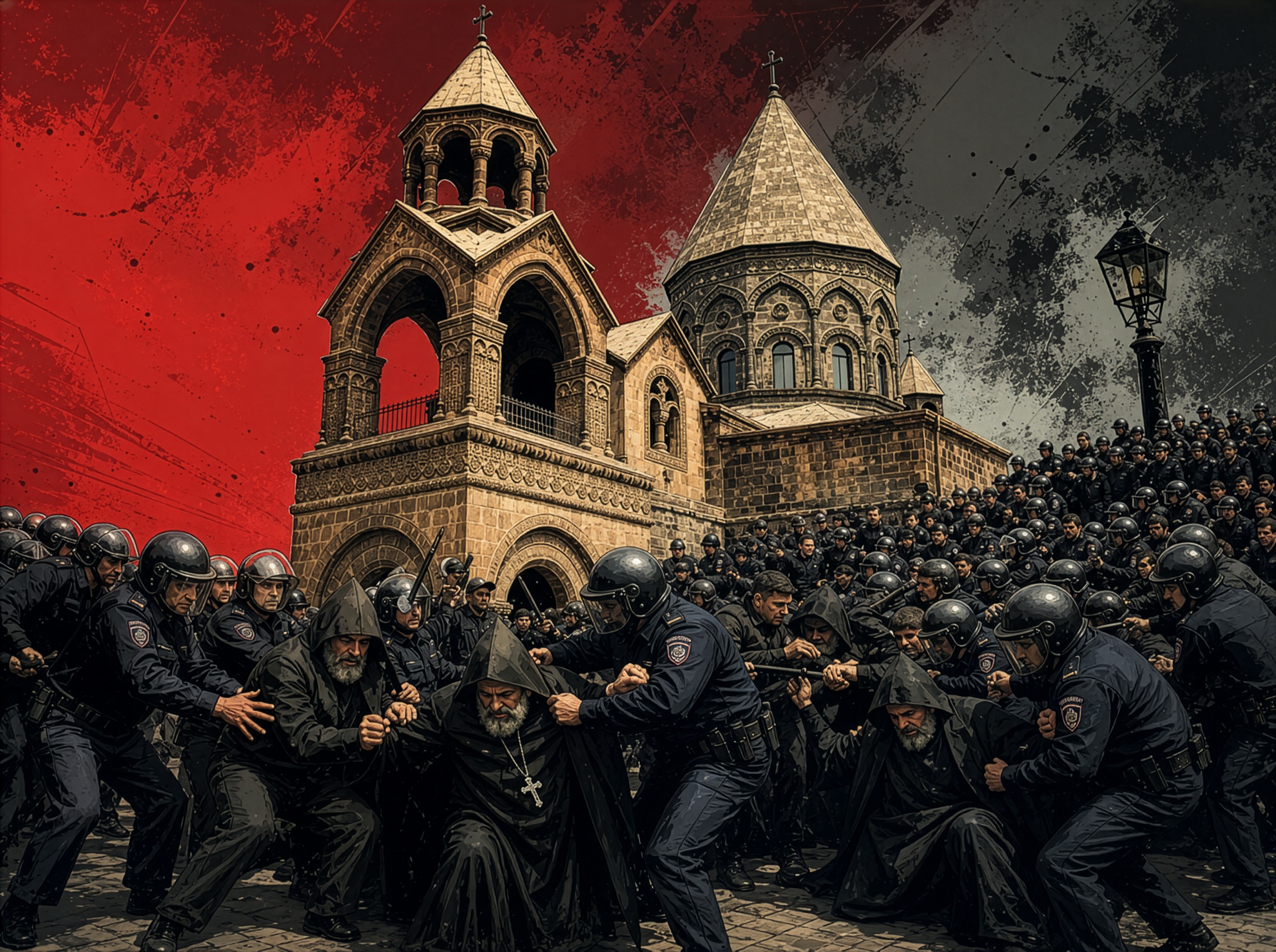
This authoritarian tendency is especially evident in the Prime Minister’s campaign against the Armenian Apostolic Holy Church (AAHC), by far Armenia’s largest religious organization and an institution inseparable from the nation’s history and identity. As this White Paper sets out, the AAHC has suffered systematic and ongoing persecution in recent years, including state-sponsored moves to depose and replace the Catholicos of All Armenians, His Holiness Karekin II, arrests and detentions of senior clerics, and efforts to stoke divisions within the Church. This targeted persecution has no legal basis and breaches both Armenia’s constitutional order and its binding obligations under international law.
The AAHC is being targeted because it is one of the few remaining politically independent institutions in Armenia. Across its long history, the Church has played a central role in preserving Armenian nationhood, and it continues to speak out forcefully in defense of the nation’s interests, a role the Constitution protects. When political unrest exploded and threatened national unity after Armenia’s disastrous defeat in the 2020 Karabakh war, the Catholicos publicly asked Prime Minister Pashinyan to step down, and urged him to find a non-polarizing replacement from within his own party. Following Azerbaijan’s ethno-religious cleansing of Nagorno-Karabakh in 2023, the AAHC has defended the rights of Armenians from the region and protested the destruction of their heritage. The Church has also consistently called for the release of the hostages held by Azerbaijan. This has predictably drawn accusations that the Church meddles in politics, a charge the Prime Minister has seized upon to justify his campaign.
But the campaign against the Church is not just an authoritarian leader seeking to quell domestic political criticism. Whether unwittingly or not, Armenia’s Prime Minister serves a historical process aimed at erasing Armenia and its people. The Church is being targeted because it stands in the way of this process.
“The spirit of the Armenian Genocide lives on”, as one of this report’s co-authors observed at a recent Armenian Genocide commemoration. This was no idle scaremongering, but a sober assessment of the insidious “one nation, two states” policy pursued by Turkey and Azerbaijan, a policy that necessitates the end of Armenia as a Christian nation possessed of political agency. Following Azerbaijan’s ethno-religious cleansing of Nagorno-Karabakh in 2023, the Turkish-Azerbaijani condominium continues to place Armenia in a chokehold, sustaining a joint embargo, raising the specter of military aggression, and conditioning any détente on demands that strike at the core of Armenian identity. This includes the removal of Mount Ararat from Armenia’s coat of arms, acceptance of the ethno-religious cleansing of Armenian Christians from Artsakh (Nagorno-Karabakh), and an end to the pursuit of international Armenian Genocide recognition.
Pashinyan has responded to this pressure by moving to integrate Armenia into the emerging Turkish-led order in the region. This move requires silencing voices inside Armenia, such as refugees from Nagorno-Karabakh and the Church, who show insufficient deference to Turkey and Azerbaijan’s dictates. Several observers have noted how the Pashinyan government’s anti-Church and anti-Karabakh rhetoric and that of official and semi-official Turkish and Azerbaijani spokesmen have converged over the past year.
To give this shift a national cover, the Prime Minister launched the “Real Armenia” initiative in February 2025. This “ideology,” as Pashinyan calls it, draws a distinction between what he conceives as “real” Armenia and “historic” Armenia. “Real” Armenia is that part of the Armenian nation which lies within the republic’s borders. This serves to delegitimize aspects of Armenian nationhood beyond the republic’s present borders, whether Nagorno-Karabakh, the voice of the diaspora, potent symbols such as Ararat, or the global Armenian Apostolic Holy Church, which has far more adherents living outside the Republic of Armenia than inside it.
Significantly, Pashinyan has signaled that he will accede to Azerbaijani demands to amend the Armenian Constitution to remove even oblique references to Nagorno-Karabakh. Although Civil Contract fell just short of the two-thirds majority needed to call a constitutional referendum, the threat has not been removed, and the Prime Minister may yet secure the parliamentary support he needs by other means. Given the ongoing campaign against the Church, there is every reason to expect that any revised Constitution would curtail the legal protections currently afforded to the AAHC, further eroding its standing in Armenian society. By stripping Armenia of its most vocal defender, such changes would weaken the country itself, serving the interests of Turkey and Azerbaijan rather than the Armenian people.
This White Paper examines the collapse in church–state relations in Armenia. It draws on the authors’ own on-the-ground research, the work of Armenian civil society experts, and input from senior Church figures. The White Paper begins by setting out the constitutional protections afforded to the AAHC and the European framework governing freedom of religion or belief. It then documents the origins and escalation of the government’s campaign against the Church, including efforts to unseat the Catholicos, interference in its internal affairs, and the arrest and detention of clerics, which are in clear breach of domestic and international law. The White Paper concludes by examining the government’s stated justifications for these actions, revealing how those justifications fall far short of the legal threshold required to make any restriction on religious freedom permissible under the European framework.
Finally, it is important to note that Western leaders and institutions have largely remained silent on the deterioration of religious freedom and the rule of law in Armenia. Worse, they have offered tacit, at times explicit, support for Pashinyan. On the eve of Ursula van der Leyen’s post-election visit to Armenia, the Head of the EU’s Delegation to Armenia, Vasilis Maragkos, congratulated the Armenian authorities on “Prosecutors Day” for their “commitment to democracy” and their efforts to “align [Armenia’s] practices with European standards.”
Armenia is being treated as a prize in a geopolitical tug-of-war rather than a democracy worth protecting. Indeed, according to Philippe Kalfayan, director of the International Observatory for Democracy in Armenia, “the international community has unfortunately misfocused its attention on securing a partisan outcome [of elections in Armenia], whether ‘pro-West’ or ‘pro-Russian’, rather than on preserving what’s most important of all: a thriving democracy.” Now that the dust of the election has settled, we urge Western governments and institutions to re-engage Pashinyan’s administration in Yerevan and press for a change of course.
A National Church: The AAHC’s Constitutional Position and Protections
While Western observers accustomed to largely secular political settlements may find the AAHC’s prominence and the Church’s full-throated defense of Armenian interests discomforting, the Armenian people broadly accept the Church’s role in their country’s national life. Indeed, recent polling by Gallup shows that the AAHC is one of Armenia’s most trusted institutions, with 77.7% of respondents evaluating the Church positively.
The AAHC’s role as a custodian of Armenian national and cultural identity is grounded in something no secular institution or political authority in Armenia can claim: an unbroken existence of over 1,700 years. As an earlier Catholicos observed, “the Armenian Apostolic Church has always been integrated in the life of the nation in an existential way; this is a historical fact that cannot be ignored.” Indeed, this history goes some way toward explaining why it commands such a prominent voice on issues affecting the Armenian nation and people, a role protected by law.
To better acquaint the reader with the AAHC’s standing in Armenia, this section outlines the Church’s constitutional position and the protections it enjoys under both domestic and international law. In doing so, it sets out the framework and standards against which the government’s conduct must be measured. As this White Paper shows, these standards are being systematically violated by the government’s campaign against the Church.
- Armenia’s Domestic Constitution
Adopted in 2015, the present Constitution establishes the legal standing of the AAHC and sets out a range of rights and protections. The Constitution recognizes the AAHC as a national church, albeit one separated from the state and guaranteed autonomy. Article 17 provides for that separation, which applies equally to all religious organizations, while Article 41.1 enshrines freedom of religion. In addition, Article 41.4 guarantees the autonomy of religious organizations, thus reflecting the established principle that religious bodies have the right to govern their internal affairs according to their own rules and traditions.
These constitutional protections are further supplemented by the 1991 Law of the Republic of Armenia on the Freedom of Conscience and on Religious Organizations. Article 17 of this law reiterates the separation of the Church from the state. It also prohibits government “interference with the law-abiding activities and internal life of the Church and religious organizations” and “the activities of any governmental body or person performing its assignments in the structure of churches and religious organizations.” As such, this provision affirms the guarantee of autonomy contained in Article 41.4 of the Constitution.
However, the Constitution does permit restrictions on religious freedom in specified circumstances. Article 41.2 provides that the “expression of freedom of thought, conscience and religion,” is not absolute and may be restricted “by law for the purpose of state security, protecting public order, health and morals or the basic rights and freedoms of others.” Where these conditions are met, the Constitution permits the authorities to limit religious freedom, potentially enabling the interference in the internal affairs of religious organizations. Notably, as discussed below, the criteria specified in Article 41.2 do not fully align with the international standard for restricting freedom of religion or belief.
Beyond the protections afforded to the Church, the Constitution also sets out the unique role of the AAHC as a custodian of national interests (Article 18.1):
The Republic of Armenia shall recognize the exclusive mission of the Armenian Apostolic Holy Church, as a national church, in the spiritual life of the Armenian people, in the development of their national culture, and in the preservation of their national identity.
This article explicitly recognizes the AAHC’s moral voice and encourages the Church in its role as the nation’s conscience. This recognition is further supplemented by the 2007 Law of the Republic of Armenia Regarding the Relationship between the Republic of Armenia and the Apostolic Armenian Holy Church. Article 2.1 of this law reiterates AAHC’s standing as a “national church,” and reasserts the AAHC’s “exclusive mission in the spiritual life of the Armenian people, the development of its national culture, and the preservation of its national identity.”
Article 2.2 of this law further restates the principle of self-governance with respect to the AAHC, while Article 5 elaborates on the unique position of the Church, noting that “the historical, spiritual, cultural, and documentary heritage of the [AAHC] is an important and inseparable part of the foundation of national identity.” Recognizing this unique position, the AAHC is accorded certain rights, such as the right to teach a special school course on the “History of the Church” (Article 8), a point to which we shall return.
- European Framework for Freedom of Religion or Belief
The constitutional settlement protecting the AAHC is further strengthened by Armenia’s membership of the Council of Europe, which means that the Church benefits from the principles and protections of religious freedom contained in Article 9 of the European Convention on Human Rights (the Convention) and the related case law of the European Court of Human Rights (ECtHR).
Article 9.1 of the Convention sets out the fundamental rights of freedom of religion or belief:
Everyone has the right to freedom of thought, conscience, and religion; this right includes freedom to change his religion or belief and freedom, either alone or in community with others and in public or private, to manifest his religion or belief, in worship, teaching, practice, and observance.
The jurisprudence of the ECtHR gives further content to the standards set out in Article 9.1. In particular, the ECtHR has ruled that the Convention does not impose an obligation on states to adopt any specific framework to regulate the relationship between religious organizations and states (i.e., full separation of church and state or the recognition of “established” or “national” churches). Instead, states are accorded “a margin of appreciation in choosing the forms of cooperation with the various religious communities.” This position reflects the diverse nature of Europe’s religious traditions and constitutional settlements, which render a “one size fits all” approach impossible. Thus, the AAHC’s special position as a national church with an “exclusive mission” does not necessarily violate Article 9, just as England’s or Denmark’s established churches comply with the standards set out in the Convention and related case law.
The ECtHR has also established important principles concerning Article 9 and the autonomy of religious organizations. In Hasan & Chaush v. Bulgaria (2000), the Court ruled:
Article 9 of the Convention must be interpreted in the light of Article 11, which safeguards associative life against unjustified State interference. Seen from this perspective, believers’ right to freedom of religion encompasses the expectation that the community will be allowed to function peacefully, free from arbitrary State intervention. Indeed, the autonomous existence of religious communities is indispensable to pluralism in a democratic society and is thus at the very heart of the protection Article 9 affords. It directly concerns not only the organization of the community as such but also the effective enjoyment of the right to freedom of religion by all its active members. Were the organizational life of the community not protected by Article 9 of the Convention, all other aspects of the individual’s freedom of religion would become vulnerable.
The judgment also ruled that “facts demonstrating a failure by the authorities to remain neutral in the exercise of their powers in this domain must lead to the conclusion that the State interfered with the believers’ freedom to manifest their religion within the meaning of Article 9 of the Convention.” These principles have since been restated in several judgments, further emphasizing the central importance of the autonomy of religious organizations. They are also directly relevant to the situation faced by the AAHC, in which the Armenian state is taking measures to interfere in the Church’s internal affairs.
The ECtHR has also ruled that states must avoid fostering divisions within religious organizations or undermining religious clerics in favor of a preferred candidate. For example, in Metropolitan Church of Bessarabia and Others v. Moldova (2001), the Court held that:
The right to freedom of religion for the purposes of the Convention excludes assessment by the State of the legitimacy of religious beliefs or the ways in which those beliefs are expressed. State measures favoring a particular leader or specific organs of a divided religious community or seeking to compel the community or part of it to place itself, against its will, under a single leadership, would also constitute an infringement of the freedom of religion. In democratic societies, the State does not need to take measures to ensure that religious communities remain or are brought under a unified leadership.
The principles set out in this case directly bear on the situation in Armenia, where the government is actively fomenting factionalism within the AAHC and seeking to install an alternative leadership over the Church.
Finally, it must be acknowledged that Article 9 of the Convention does afford states a degree of latitude within which religious freedom may be restricted (Article 9.2). While the freedom of thought, conscience, and religion is an absolute right and unconditional, the “freedom to manifest one’s religion or beliefs” can be limited in certain narrowly defined circumstances. Article 9.2 of the Convention provides that such restrictions must be (i) prescribed by law (i.e., accessible and formulated with sufficient precision to enable citizens to regulate their conduct); (ii) necessary in a democratic society (and also proportionate to the intended aim); and (iii) in the interests of public safety, for the protection of public order, health or morals, or for the protection of the rights and freedoms of others. Notably, national security is not specified as a lawful ground for limiting the freedom to manifest one’s religion or beliefs. As the ECtHR has ruled:
far from being an accidental omission, the non-inclusion of that particular ground (i.e., national security) for limitations in Article 9 reflects the primordial importance of religious pluralism as “one of the foundations of a ‘democratic society’ within the meaning of the Convention” and the fact that a State cannot dictate what a person believes or take coercive steps to make him change his beliefs.
Significantly, the criteria for lawful restrictions of religious freedom set out in Article 9.2 of the Convention have not been replicated with precision in Article 41.2 of the Armenian Constitution. Article 41.2 fails to impose the requirement that these restrictions be “necessary in a democratic society.” Article 41.2 also specifies “state security” as a ground to limit the “expression of freedom of thought, conscience and religion,” thus contravening the deliberate exclusion of national security from Article 9.2 of the Convention.
Critically, the Armenian authorities have failed to advance any legal justification for their restrictions on religious freedom that satisfies the criteria of Article 9.2 of the Convention. As the sections that follow document, the Prime Minister has sought to rely, without any substantive evidence, on national security grounds, precisely the basis that Article 9.2 deliberately excludes.
Restrictions on the Church: The Early Phase of the Campaign
Having established the constitutional position of the AAHC and its protections in domestic and international law, we now turn to the Armenian government’s campaign against the Church and its leadership. While much of the attention has centered on the recent intensification of this campaign, the seeds of the government’s antipathy towards the Church were sown several years earlier. This section details the early stage, marked by an undermining of the AAHC’s role in national life. Although the points raised are not exhaustive, they indicate the direction of travel under Prime Minister Pashinyan’s rule.
Pashinyan came to power in 2018 following what political scientists have termed a “velvet revolution.” However, despite promising a new era of democratization strengthened by the rule of law, there were early signs that he would fall short of this goal. As Dr. Arsen Gasparyan, an expert on politics and international relations, has observed, this period was marked by an attempt at “radical secularization” that ultimately sought to “repress and exclude the [AAHC] from the country’s public life.”
This exclusionary impulse first surfaced, in symbolic form, at the commemoration of the 100th anniversary of the Battle of Sardarapat on 28 May 2018. The battle holds a special place in Armenia’s historical memory, and the AAHC is traditionally credited with spiritual leadership that galvanized civilians and soldiers alike, helping pave the way for the establishment of the first Armenian republic in 1918. Accordingly, Catholicos Karekin II and senior clerics were invited to attend the commemoration. Yet, although the Catholicos sat alongside Pashinyan on the stage, the Prime Minister made no mention of the Church’s role in his address.
A generous interpretation would be that this was an oversight. But it soon became clear that the political mood was shifting. A new civic initiative, New Armenia, New Catholicos, began to agitate against the Catholicos, staging pickets and demanding his resignation. Led by Khoren Hovhannisyan, a defrocked cleric and outspoken critic of Karekin II, the movement published lurid accusations on its online platform about the AAHC and its spiritual leader. These claims were then disseminated by publicly owned TV stations, which helped to set the scene for the government’s later attacks on the Church.
Matters came to a head on 14 July 2018 when, as documented in the US State Department’s 2018 Armenia Religious Freedom Report:
protesters blocked the Catholicos’s vehicle at the Gndevank monastery complex in the Vayots Dzor Region and blocked him as he tried to walk away from the venue. Protesters insulted him in the presence of the police. According to an [AAHC] priest from the Vagharshapat Cathedral, in addition to pushing and pulling him, the protesters restricted the Catholicos’ freedom of movement and threatened to lock him in the monastery.
At least at this stage, Pashinyan did not publicly get involved in the protests, citing concerns about the separation of church and state. However, even if the Prime Minister did not openly support New Armenia, New Catholicos, the initiative set the tone and substance of the Prime Minister’s later incendiary claims against the Church and its spiritual leader.
The government’s failures during the Second Nagorno-Karabakh War deepened the growing crisis. Armenians at home and abroad blamed Pashinyan’s administration for Armenia’s defeat, and protesters staged peaceful demonstrations in December 2020 calling on the Prime Minister to resign. Reflecting this mood, the Catholicos issued his own, legitimate and respectful, call for the Prime Minister to stand down. At no point did the Catholicos call for a revolutionary seizure of power or an assault on Armenia’s constitutional order. Rather, he exercised the AAHC’s constitutional “exclusive mission” to defend and preserve Armenian national identity, which had been imperiled by Azerbaijan’s assault on Nagorno-Karabakh.
The government responded to Catholicos Karekin II’s call for Pashinyan’s resignation by removing the religious studies course created and taught by the Church from the school curriculum. This violated Article 8 of the 2007 Law of the Republic of Armenia Regarding the Relationship between the Republic of Armenia and the Apostolic Armenian Holy Church, which, as noted above, provides the AAHC the right to teach its Church history course in public schools.
The loss of Nagorno-Karabakh in 2023, including the ethnic cleansing of its Armenian population, provided a fresh pretext for confrontation. Five months after Azerbaijan initiated a blockade of Nagorno-Karabakh, and four months prior to the final ethnic cleansing of the region, Pashinyan recognized Nagorno-Karabakh as part of Azerbaijan. This step was a reversal of thirty-two years of Armenian policy, which had always emphasized the right of Nagorno-Karabakh’s people to self-determination.
In response, the AAHC’s Supreme Spiritual Council declared:
The authorities of Armenia should renounce actions that violate the dignity of the nation and oppose the humiliating ambitions and demands of foreign enemies with realistic and exclusively pro-Armenian positions, resolutely defending the non-negotiable right of the people of Artsakh [Nagorno-Karabakh] to self-determination.
Since then, the AAHC and its spiritual leader have continued to defend the rights of Armenians from Nagorno-Karabakh and protest against the desecration of their religious and cultural heritage by Azerbaijan. In response, public broadcasters canceled Catholicos Karekin II’s annual New Year address for 2024, the first time in Armenia’s post-independence history. This silencing of Armenia’s spiritual leader was both literal and deeply symbolic.
The Prime Minister then announced the need for a new Constitution, a move that fuelled widespread fears that the Prime Minister was acting under pressure from Azerbaijan. Armenia’s constitution refers to its declaration of independence, which in turn refers to Nagorno-Karabakh. Azerbaijan has long demanded that Armenia amend its constitution to remove this reference. A statement issued by the Supreme Spiritual Council of the AAHC described the initiative to adopt a new Constitution as “bewildering,” and observed that “it is widely perceived in public circles also as a consequence of external coercion.”
From then on, the government continued to take measures to silence the AAHC and erase its presence from public events, including the annual commemoration of the Battle of Sardarapat on 28 May 2024, when the Catholicos and his retinue were blocked from attending. The Church released a statement describing the incident as “yet another manifestation of shameful and anti-national activities of the authorities.” While such actions encroached on the AAHC’s constitutional mandate, they were merely a foretaste of the more severe infringements that followed the next year.
Intensification of the Campaign Against the Church
What began as an effort to sideline the AAHC and undermine its “exclusive mission” has since escalated into a systematic assault on the rights of the Church and its members, one that violates both the domestic and international frameworks for freedom of religion or belief. Since May 2025, this campaign has not only intensified but also diversified. It now takes three principal forms: (i) denigrating the Catholicos and seeking to replace him; (ii) other means of interfering in the Church’s internal affairs and fomenting divisions; and (iii) arresting clergy and laity on spurious charges. Each raises concerns about freedom of religion or belief in Armenia and presents serious challenges to the protections guaranteed by the Constitution and international law.
- Attacks on the Catholicos and the Plan to Remove Him
The Catholicos’s address at the World Council of Churches conference on 27 May 2025 marked a turning point in the Church crisis. Convened to raise awareness about the threats to the heritage of Nagorno-Karabakh and the rights of its people, the Catholicos used his speech to denounce Azerbaijan’s “continued assaults on the Armenian spiritual and cultural heritage and its sacred historical sites,” including the “continued barbaric destruction of ancient Armenian monuments, Christian holy sites, settlements, and cemeteries.” This statement, as well as the Church’s broader efforts to defend Nagorno-Karabakh, were consistent with the AAHC’s “exclusive mission” under Article 18 of the Constitution.
For some Armenian civil society observers, such efforts resemble Pope Leo’s willingness to raise contested moral issues, even in the face of significant political opposition. Just as the Pope has drawn criticism for doing so, the AAHC’s defense of Christian heritage and values produced a swift political backlash.
Catholicos Karekin II’s address was greeted with outrage by Pashinyan, who launched a series of extraordinary attacks across several Facebook posts. These posts were crude in both tone and content, and they were entirely unbecoming of an elected leader. In one infamous message directed to the Catholicos, Pashinyan wrote: “Your Holiness, go on keep banging your uncle’s wife, what business do you have with me?” Such statements underscored the Prime Minister’s failure to maintain the neutrality and fair, non-arbitrary treatment of the AAHC required under Article 9 of the Convention. Significantly, the Prime Minister’s wife also joined the fray, making baseless accusations that AAHC clerics are “paedophiles”, “black-robed maniacs” and “perverts,” led by the “country’s main mafia boss.”
This stream of offensive messages culminated in the Prime Minister’s demands for the resignation of the Catholicos. On 30 May 2025, Pashinyan wrote: “The Republic of Armenia should have a decisive vote in the election of the Catholicos of All Armenians. Candidates for the Catholicos should pass a background check. This issue must be resolved once and for all.” In response, the Supreme Spiritual Council of the AAHC issued a firm statement, emphasizing that “matters of the Church are governed by ecclesiastical canons and regulations and lie beyond the jurisdiction of state and political authorities.” This statement clearly reflected the position set out in the Armenian Constitution, as well as the European Convention on Human Rights and its related case law. It certainly reflected the government’s obligation to act as a neutral and impartial actor.
On 10 June 2025, the Prime Minister announced his intention to establish a “coordinating council” to “liberate” the Mother See of the AAHC and to organize the election of a new Catholicos. Pashinyan confirmed that he would take responsibility for selecting the first 10 members of this council and published his personal Gmail account, encouraging those interested in participating to contact him directly. No information on how members would be selected or on the council’s terms of reference was published.
This plan represented a direct encroachment on canon law and on the AAHC’s own process for electing its spiritual leader, a process long distinguished by its democratic and conciliar character. As Siranush Sahakyan, the internationally respected director of the International and Comparative Law Center in Yerevan, rightly observed at that time, “the removal of religious leaders by public authorities raises serious concerns under international human rights law,” which “enshrine the principle of religious autonomy, affirming the right of religious communities to govern their internal affairs, especially the selection and retention of their leaders, free from state interference.”
On 4 January 2026, months after first suggesting the plan, the Prime Minister announced via Facebook the establishment of the “coordinating council.” He published an official document stating that the council would elect a locum tenens, hold elections for a new Catholicos, and adopt a new charter to ensure the moral conduct of the clergy and the transparency of the AAHC’s financial operations. Shortly after, at a rally in Yerevan on Christmas Eve, Pashinyan called for the Church to be “freed” and vowed to “return it to the people.”
Significantly, the work of the coordinating council was not confined to the document Pashinyan had issued: the election manifesto of his Civil Contract party made it a formal policy commitment. In doing so, the Prime Minister presumably sought to give his plans the legitimacy of an electoral mandate. The manifesto asserted that Civil Contract “respects the freedom of religion and religious belief of all citizens and reaffirms that the Republic of Armenia is a secular state where, according to the Constitution, religious organizations are separate from the state.” Notwithstanding this declaration of respect for the autonomy of religious organizations, the manifesto then claimed that “the renovation of the Armenian Apostolic Church is a vital necessity.” In keeping with his earlier Facebook announcement, the manifesto then set out the following “roadmap” for the “renovation” of the Church:
(a) Removal of the de facto head of the Armenian Apostolic Church (retirement);
(b) Election of a locum tenens as Catholicos in accordance with the established procedure;
(c) Adoption of a statute of the Armenian Apostolic Church: the statute shall establish mechanisms for safeguarding enshrined principles, ensuring financial transparency, and upholding the integrity of the clergy;
(d) Election of Catholicos of All Armenians in accordance with the established procedure.
Given the electoral success of Civil Contract, there is every chance that this “roadmap” will now be implemented, regardless of the fact that it violates the Armenian Constitution’s guarantees concerning the separation of church and state, as well as the protections against interference in the internal affairs of religious organizations in both domestic and international law.
- Other Means of Internal Interference and Fomenting Divisions
While the plan to remove and replace the Catholicos is the centerpiece of the Prime Minister’s campaign against the Church, it has been accompanied by broader efforts to interfere in the AAHC’s internal affairs and sow divisions within its ranks. This only serves to demoralize members of the Church, thus further endangering its position in society.
Just prior to the establishment of the “coordination council,” a group of ten bishops publicly signaled their intention to support the Prime Minister’s efforts to elect a new spiritual leader. They called for the resignation of the Catholicos, which they claimed was a “nationwide mission” and a “long-held dream and desire of clergy and believers.” These bishops then signed the founding document of the “coordinating council,” published by Pashinyan on 4 January. The participation of these bishops is significant: it enabled the government to present a state-driven project as an internal, grassroots movement for reform, lending a veneer of ecclesiastical legitimacy to what was in substance state interference in the Church’s affairs.
By turning a faction of clergy against their own spiritual leader, the authorities engineered the very kind of internal schism that ECtHR jurisprudence regards as incompatible with the State’s duty of neutrality towards religious communities. As the ECtHR ruled in Metropolitan Church of Bessarabia and Others v. Moldova, the State must not favor or promote one group over another within a divided religious community. It is also worth noting that there is some historical precedent for this attempt to foster schisms. Pashinyan’s approach is drawn from the Soviet playbook, when the Communist authorities created a similar structure in Armenia, the so-called “Free Church”, to sow division and weaken the Church. The same method is employed now by Pashinyan, with the same goal as the Soviet regime: political control of the Church.
At the same time, the authorities have taken measures that directly interfere with ecclesiastical prerogatives. On 10 January 2026, the Mother See of Etchmiadzin relieved Bishop Gevorg Saroyan, one of the bishops who had signed the statement against the Catholicos, of his duties. Saroyan then filed a civil lawsuit to secure his reinstatement, a highly unusual step given the primacy of canon law in such disputes. The court then ordered the reinstatement of Saroyan, pending final adjudication.
On 27 January 2026, the Catholicos defrocked Saroyan for violating canonical discipline and his vow of obedience. Although this decision fell squarely within the competence of the Catholicos as a matter of canon law, the Catholicos and six other bishops were charged in February 2026 with “obstructing the execution of a judicial act” (i.e., by defrocking the bishop). By criminalizing an internal act of ecclesiastical discipline, the authorities did the very opposite of what the European Convention on Human Rights requires. As the ECtHR held in Sindicatul “Păstorul cel Bun” v. Romania (2013), “respect for the autonomy of religious communities recognized by the State implies, in particular, that the State should accept the right of such communities to react, in accordance with their own rules and interests, to any dissident movements emerging within them that might pose a threat to their cohesion, image or unity.”
Significantly, the charges led to travel bans on the Catholicos and the bishops, preventing them from attending a synodal meeting in Austria held between 16 and 19 February 2026. They also prevented the Catholicos from attending the funeral of Ilia II, the Patriarch of the Georgian Orthodox Church. These travel bans were clearly calculated to disrupt the synod’s normal functioning and the international duties of the Catholicos.
The Prime Minister’s interference with the internal affairs of the AAHC has also encroached on matters that are more straightforwardly spiritual, matters wholly within the competence of the Church. In a Facebook post of 7 December 2025, Pashinyan declared that since the AAHC had been established by the state in 301, he believed it would be “appropriate for choirs in all churches to perform the national anthem of the Republic of Armenia before Sunday liturgy.” This provoked further disquiet among the clergy and laity, as it marked an attempt to interfere with the liturgical order. Shortly after this announcement, Pashinyan publicly admitted that he had ordered the National Security Service to censor the divine liturgy of the Church by pressuring clerics to omit the standard commemoration of the Catholicos, further proof of state interference in the sacred religious rites of the Church, which can in no way be justified under domestic or international law.
- Arrests and detentions of clerics
The travel bans against the Catholicos and bishops are part of a broader campaign of persecution against clerics and lay members of the AAHC. Large numbers of individuals have been arrested and charged on false or spurious grounds, with reports in some cases indicating that the charges rely on tampered evidence. Pre-trial detention has been used indiscriminately in several of these cases, in keeping with a broader pattern in which such detention serves as a punishment in and of itself, and as a warning to others.
Considered in isolation, many of these cases do not appear to violate Article 9 of the Convention. Instead, the arbitrary and excessive resort to pre-trial detention raises serious concerns under Article 5, which protects the right to liberty and security. Resorting to spurious charges and, in some instances, tampering with evidence, engages the right to a fair trial under Article 6. At the same time, there are also legitimate concerns that several of the arrests penalize conduct amounting to protected speech, thereby infringing the right to freedom of expression under Article 10.
However, taken together, the pattern of these arrests is unmistakable. These cases fall overwhelmingly on the clergy and faithful of the AAHC and form part of a coordinated, targeted, and discriminatory campaign against the Church. Viewed as a whole, they amount to religious persecution and so engage the very guarantees of religious freedom that Article 9 of the Convention exists to protect.
While there is insufficient space to detail every arrest and detention, Annex One of this White Paper lists the cases we are currently aware of. For further information on the arrests of clerics and lay members, readers are also encouraged to consult the detailed reports produced by the Armenian Center for Political Rights.
Four particularly concerning cases, however, merit closer examination. Within months of the World Council of Churches conference in May 2025, a third of all archbishops based in Armenia had been imprisoned. Those detained included Archbishop Bagrat Galstanyan, Archbishop Mikael Ajapahyan, Bishop Mkrtich Proshyan, and Archbishop Arshak Khachatryan. Their cases are summarized briefly below.
Archbishop Bagrat Galstanyan, the head of Tavush Diocese, was arrested on 25 June 2025 and detained along with several of his parishioners and supporters. Archbishop Bagrat had led a civic initiative opposing the 2024 demarcation and delimitation process along the border with Azerbaijan in the Tavush region. There were legitimate concerns that this process was overriding the wishes of local citizens. Known as “Tavush for the Homeland”, the civic initiative encouraged Armenian citizens to march from Tavush to Yerevan for a rally on 9 May 2024, at which Archbishop Bagrat called for Pashinyan’s resignation. Archbishop Bagrat’s popularity and ability to rally people to protest against unilateral territorial concessions alarmed the government. His arrest was based on accusations that he had acquired the “means and tools necessary to commit a terrorist attack and seize power.” Archbishop Bagrat flatly denies the charge. As the Armenian Center for Political Rights has reported, there are serious concerns that evidence related to this case was tampered with. Archbishop Bagrat’s pre-trial detention was extended repeatedly, and the authors of this White Paper were able to visit him during his incarceration. He was finally released on house arrest in early June 2026, and the case is ongoing.
Archbishop Mikael Ajapahyan, the head of Shirak Diocese, was arrested and detained on 28 June 2025, after a tense standoff with law enforcement authorities. He was accused of making public calls to seize power, based on a comment he had made repeatedly in interviews since 2020, that the military should remove Pashinyan from power. In a sign that the charges were politically motivated, Armenia’s Prosecutor General’s Office had already deemed Archbishop Mikael’s comments did not meet the criminal threshold in 2024. In the context of the Prime Minister’s attacks on the Church, it is highly suspicious that the Prosecutor General’s Office changed its mind and saw fit to bring charges a year later, shortly after the intensification in the campaign against the Catholicos began in earnest. Archbishop Mikael was arrested after armed units laid siege to Etchmiadzin, where he was residing. He handed himself in the next day, asserting that “the accusation is completely fabricated.” After being placed in pre-trial detention, he was sentenced to two years’ imprisonment on 3 October 2025. He appealed to the Court of Appeal and, in February 2026, was placed under house arrest. In June 2026, the Court of Appeal voided his previous conviction on a technicality, leaving the future of his case uncertain.
Following these arrests, the authorities widened their net. On 16 October 2025, six clerics of the AAHC were detained, including Bishop Mkrtich Proshyan, the head of the Aragatsotn Diocese. He was charged with obstructing the exercise of electoral rights and coercing participation in political rallies during the 2021 parliamentary elections. Bishop Proshyan, a nephew of Catholicos Karekin II, was remanded in pre-trial detention for two months. The AAHC swiftly denounced the arrests, condemning them as further evidence of the Armenian government’s “systemic pressure on the Armenian Church.” Bishop Mkrtich was released on house arrest in February 2026 and continues to protest his innocence.
Finally, Archbishop Arshak Khachatryan, the Chancellor of the Mother See of Holy Etchmiadzin, was remanded in pre-trial detention on 5 December 2025, accused of orchestrating the planting of narcotics in the backpack of a demonstrator at a 2018 protest against the Catholicos, in an apparent attempt to frame him. A statement issued by the Mother See declared that “this is a manifestation of repressions recently unleashed against our Church and a continuation of the politically motivated persecution of our clergy […]. The detention of high-ranking clergy on manufactured accusations is yet another expression of the authorities’ anti-Church policy and fomenting of hostility against our clergy.” Archbishop Arshak was released from pre-trial detention in early March 2026, but remains under administrative supervision, blocked from leaving the municipality where the Mother See is located. His case has since come to trial. He continues to maintain his innocence.
Cumulatively, these arrests mark a sharp escalation in the campaign against the Church. Within a single year, archbishops, priests, and lay believers alike have been detained on charges ranging from the implausible to the absurd, held for months in pre-trial detention, and prosecuted on the strength of evidence that the Church and independent observers allege was fabricated or tampered with. Each successive detention has been calculated to exert pressure on a Church enduring the worst persecution it has faced since the Soviet era. Each step brings the campaign closer to its ultimate goal: to weaken the Church by removing the Catholicos and subordinating it to the will of the state.
The Absence of a Lawful Basis for the Campaign Against the Church
The Prime Minister’s campaign against the Church contravenes the standards and protections for freedom of religion or belief established in both domestic and international law. However, as this White Paper has noted, a state may restrict religious freedom, but only in narrowly defined circumstances and only where the criteria prescribed by Article 9.2 of the European Convention of Human Rights are satisfied. The government’s discriminatory and arbitrary conduct renders its campaign inherently unlawful; nonetheless, it is worth examining whether the Prime Minister and his officials can mount any case at all for the lawfulness of their actions, not least the attempt to remove the Catholicos.
Firstly, far from being “prescribed by law”, the campaign against the Church proceeds in defiance of it. The Armenian government has to date failed to adequately prescribe its actions by law. There exists no legislation providing a legal basis that is accessible and formulated with sufficient precision to enable the Church and its leadership to regulate their conduct. The document establishing the “coordinating council” was announced by the Prime Minister on social media and has no foundation in any statute or other legal instrument; it does not constitute law and cannot lawfully bind the Church or displace its canonical self-governance. On the contrary, as set out above, the government’s actions run directly counter to the guarantees of Church autonomy and the separation of church and state contained in the Armenian Constitution and related legislation.
Secondly, the Armenian government has failed to show why the campaign against the Church is necessary and proportionate. A restriction qualifies as “necessary in a democratic society” only where it answers a pressing social need and is proportionate to a legitimate aim, and the burden of demonstrating this falls on the State. The Armenian government has identified no such need. Nor are the measures employed remotely proportionate: orchestrating the removal of the Catholicos, interfering in the internal affairs, orchestrating divisions, and prosecuting clergy go far beyond anything a genuine and pressing concern could justify. Where the State reaches into the internal organization and leadership of a religious community, the ECtHR demands the most compelling of justifications, a threshold the Armenian government comes nowhere near meeting.
Thirdly, and relatedly, the government has failed to identify any legitimate aim for its restriction of religious freedom (public safety, public order, health or morals, or the rights and freedoms of others). Instead, the Prime Minister has resorted to nebulous and unsubstantiated grounds, several of which fall outside the permissible bases set out in Article 9.2 of the Convention altogether.
With respect to the plan to replace the Catholicos, Pashinyan asserted in a Facebook message of 2 June 2025 that “if it turns out that Karekin II has indeed violated his vow of celibacy and has a child, then he cannot be the Catholicos of all Armenians.” He offered no evidence to substantiate this claim, which, if true, should be left to the Church to resolve in accordance with canon law. In the same message, Pashinyan described the Catholicos as a “threat to spiritual security” and to “state security.” He did not explain what he meant by “spiritual security”, nor did he describe how the Catholicos threatened “state security.” Regardless, as we have noted, national security, assuming that is what he meant, is not a permissible ground for restricting religious freedom.
The national security aim as a motivating factor was later developed in the Civil Contract manifesto, which claimed that the AAHC is involved in a “hybrid struggle against the independence and sovereignty of Armenia.” While the manifesto skirted the issue of the alleged culprit behind this “struggle”, it was clear that Russia was the implicated party. In the context of a highly polarised election, such claims were cynically designed to play on the West’s heightened fears about Russian influence.
To date, the Armenian authorities have failed to provide sufficient evidence to support their accusations. Prior to the election, it was reported that Archbishop Yezras, the younger brother of Catholicos Karekin II, was a KGB agent. However, the KGB identification card used to support the claim was written in Armenian, whereas such documents were produced only in Russian during the Soviet period. Furthermore, such claims relate to a communist-era security agency that involved whole swathes of Armenian society, including teachers, police officers, and state officials, not just the clergy. To single out the Church on this basis is therefore highly selective. Indeed, if past ties to the KGB were genuinely disqualifying, much of Armenia’s professional and political class would stand implicated alongside it.
More importantly, as Isabella Sargsyan, an internationally recognized human rights expert and a past member of the OSCE/ODIHR Panel of Experts on Freedom of Religion or Belief, has observed, “to date, the Armenian government has not produced concrete evidence demonstrating that the Catholicos or other members of the clergy have engaged in activities that would constitute offences under the Republic of Armenia’s criminal code.” This includes evidence of collusion with Russia’s FSB or any other foreign state security organization.
Finally, the Prime Minister resorted to a different argument in a speech given to the European Parliament on 11 March 2026. Pashinyan referred to the protests led by Archbishop Bagrat, stating that:
With the encouragement of the de facto head of our church, one of the archbishops in Armenia had started a movement demanding not only that the demarcation not be carried out, but also that the Karabakh movement be essentially activated, in other words, the conflict. Tens of thousands of citizens, succumbing to this information campaign carried out by high-ranking clergymen and their supporting opposition forces, who claimed that the government was preparing to cede sovereign territories of Armenia and the ancient churches and settlements located there to Azerbaijan, took to the streets.
Pashinyan further asserted that some of the clergy “have assumed the leadership of the war party in the Republic of Armenia.” In follow-up comments after his speech, Pashinyan accused the Catholicos and clergy of referring to the Republic of Artsakh during the liturgy. “What does this mean? It means conflict.”
This statement hints at a national security requirement to restrict the AAHC’s religious freedom, though it is unclear. This statement, however, clearly indicates that the campaign against the Church is predicated on the desire to limit its ability to champion national causes and to exercise its legitimate rights to free speech and peaceful protest, all of which flow from its constitutional mandate. Furthermore, by suggesting that the AAHC wishes to “activate the Karabakh movement, in other words, the conflict,” the Prime Minister recasts peaceful opposition to the surrender of sovereign territory as an effort to reignite war. This is a cynical inversion of the truth. The AAHC has simply acted on its duty to protect Armenia’s national interests, and by raising concerns about territorial concessions and the fate of Armenian heritage, has exercised its rights to free speech.
None of the grounds advanced by the government withstands scrutiny. Rather, its stated justifications are unsubstantiated and serve as a pretext for what is, in truth, a political project to subordinate the Church to the State. Measured against the requirements of Article 9.2, the campaign fails at every turn: it rests on no proper basis in law, serves no pressing social need, and pursues no legitimate aim recognized by the Convention. In short, it amounts to an unlawful interference with religious freedom and an assault on the autonomy of AAHC that is incompatible with both the Armenian Constitution and the European Convention on Human Rights.
Conclusion
We can safely assume that Pashinyan’s electoral success means a continuation of the status quo. The government will now use its electoral victory and support from Azerbaijan, Turkey, the EU, and the U.S. to implement its manifesto, which includes plans to remove and replace the Catholicos. This will only further demoralize the Church and will reverberate among the faithful across the diaspora. Whether the broader efforts to sow division and arrest clergy and laity will now abate remains to be seen. The net result of this campaign is the further deterioration of democracy and the rule of law.
As this White Paper has shown, the government’s campaign against the AAHC is not a lawful exercise of state authority but a sustained assault on the rights of a religious community. Nor is it merely an episode of domestic political score-settling. Through the “Real Armenia” ideology, the effort to subdue the Church forms part of a wider project to subordinate Armenian society and politics to the demands of Turkey and Azerbaijan. This effort only serves to weaken the country from within by dismantling an institution that has for seventeen centuries anchored Armenian identity and given voice to the nation’s territorial and national claims. In silencing the Church, the government does not strengthen Armenia’s sovereignty but corrodes it, advancing the interests of Azerbaijan and Turkey at the expense of the Armenian people.
Particularly concerning are plans to introduce a new Constitution, as this may offer further avenues to undermine the Church and curtail its rights and responsibilities, notwithstanding the protections under the Convention. Armenia’s Minister of Justice, Srbuhi Galyan, announced in February 2025 that the text of the new Constitution would be ready before the June 2026 elections. During its congress in September 2025, Civil Contract reiterated its intention to adopt “a new Constitution of the Republic of Armenia through a national referendum,” thereby establishing a “fourth republic” on the basis of the “Real Armenia” ideology. Galyan then confirmed on 16 March 2026 that the text of the new Constitution, prepared by the Constitutional Reform Council, had been finalized. However, despite Civil Contract’s electoral success, the draft text remains unpublished.
Although Pashinyan’s party fell just short of the two-thirds majority required to call a referendum on the new Constitution, there remain concerns that the threat has not been entirely removed, and that the Prime Minister may yet subvert the rules or cajole the parliamentary support he needs to secure the outcome he seeks. This may well provoke widespread protest in Armenia, since polls consistently show that Armenians oppose any constitutional changes demanded by Azerbaijan.
For his part, the Catholicos, despite the persecutions, remains resolute:
When matters arise in our nation, the church expresses her attitude. This is not interference or involvement in politics. Such persecutions happened under Stalin, but we are convinced through the faith of our people, and the vigilant actions of the clergy, we will be able to overcome the challenges. It is around the throne of the Catholicos that the nation is embraced.
We can expect His Holiness Karekin II to continue to defend the Church and its rights.
Finally, just prior to the election, CSI published five action points for the new government of Armenia. These were: (i) respect religious freedom and the autonomy of the Armenian Apostolic Church; (ii) work for the unconditional release of the Armenian Christian hostages held in Baku; (iii) advocate for the preservation of the Armenian Christian heritage of Nagorno-Karabakh; (iv) release the political prisoners held in Armenia; and (v) support the Swiss Peace Initiative for Nagorno-Karabakh. The election victory of Pashinyan’s Civil Contract party casts serious doubt over whether these goals will be met.
So far, there are few signs that Washington or Brussels will break from their near-complete support for Prime Minister Pashinyan, even to demand cosmetic improvements to the human rights situation in Armenia. Yet it would be prudent for both Western power centers to reconsider their approach, not only to avoid undermining their own human rights commitments, but also because of the consequences of ceding the entire region to an increasingly assertive Turkish-Azerbaijani axis. A strong Armenia with a vibrant civil society could be a valuable friend to the West; instead, American and European policy is aiding Armenia’s authoritarian turn, leaving the country sharply divided and weak. For the sake of Armenian democracy and the country’s future prosperity, this policy must end.
Recommendations
The findings of this report warrant a recalibration of U.S. policy toward Armenia. The United States has a legitimate strategic interest in a sovereign, stable, democratic Armenia capable of resisting external coercion and developing deeper relations with the West. Those interests, however, are not served by treating support for the incumbent Armenian government as synonymous with support for Armenia itself. The report documents substantial concerns regarding state interference in the internal affairs of the Armenian Apostolic Holy Church, efforts to influence its leadership, restrictions on senior clergy, and the use of criminal proceedings and pre-trial detention, all within a broader environment of deteriorating institutional independence. It further concludes that Western governments have responded inadequately to these developments, allowing geopolitical considerations to overshadow concerns regarding religious freedom, pluralism, and the rule of law.
This distinction should become central to American policy. A strong U.S.–Armenia relationship should strengthen Armenian sovereignty and democratic institutions rather than confer unconditional political legitimacy on any particular government. The United States need not take a position on internal theological disputes, the performance of the Catholicos, or Armenian partisan politics. It should, however, insist on a principle deeply embedded in American democratic practice: the state may investigate unlawful conduct by individuals, but it should neither select religious leaders nor restructure religious institutions to suit political objectives. European human-rights jurisprudence cited in this report similarly emphasizes state neutrality and the autonomous existence of religious communities.
Accordingly, the United States should pursue the following actions:
- Make religious freedom and institutional autonomy an explicit component of the United States–Armenia bilateral relationship. The Secretary of State, senior State Department officials, and the U.S. Embassy in Yerevan should communicate, both privately and publicly, that continued improvement in bilateral relations requires respect for freedom of religion, due process, political pluralism, and the institutional autonomy of the AAHC and all religious communities. The United States should make it clear that the selection, removal, or replacement of a Catholicos is an ecclesiastical matter and that Washington would not recognize or politically legitimize a Church leadership arrangement imposed through state action. This position would not constitute support for any individual cleric; it would affirm the principle of religious institutional autonomy documented throughout this report.
- Separate support for Armenia from unconditional support for the Armenian government. U.S. officials should make clear that strategic cooperation with Armenia, including security, economic, energy, and institutional partnerships, is intended to strengthen the Armenian state and its people, not to endorse any particular domestic political actors. Washington should continue programs that enhance Armenia’s sovereignty and resilience while subjecting democracy- and governance-related cooperation to credible human-rights benchmarks. This would avoid the counterproductive choice between disengaging from Armenia and overlooking democratic regression. As the report argues, a strong Armenia with a vibrant civil society is ultimately a more reliable American partner than a politically weakened and internally divided state.
- Establish specific and measurable rule-of-law benchmarks. U.S. diplomatic engagement should seek identifiable changes rather than general assurances concerning democracy. These should include the cessation of state involvement in the selection of Church leadership; non-interference in liturgy, canonical discipline, and internal Church governance; the removal of unjustified travel restrictions on clergy; adherence to due process protections; and the avoidance of punitive or excessive pre-trial detention. Where criminal allegations are made against clerics or political actors, the United States should insist not that charges be automatically dismissed, but that proceedings meet recognized standards of evidence, judicial independence, proportionality, and a fair trial. The report documents travel restrictions, prosecutions, and allegations of excessive pre-trial detention that warrant sustained scrutiny.
- Increase direct U.S. monitoring and public reporting. The U.S. Embassy should systematically meet with representatives of the Mother See, dissenting clergy, independent civil society organizations, defense attorneys, human rights monitors, opposition representatives, and government officials. Embassy personnel should observe significant trials where practicable and report on due-process concerns. The Department of State’s annual human rights and international religious freedom reporting should explicitly examine state interference in ecclesiastical governance, the treatment of detained clergy, restrictions on religious activity, and any governmental efforts to favor one faction of the Church over another. The purpose should be to create an authoritative factual record rather than allow the issue to be reduced to competing political narratives.
- Subject any constitutional reform affecting religious freedom to heightened scrutiny. The United States should not endorse constitutional change in Armenia merely because it is presented as part of democratic modernization or Western integration. Any new constitution should be evaluated according to whether it preserves freedom of religion, separation of Church and state, institutional autonomy, due process, and genuine democratic participation. U.S.-funded technical or rule-of-law assistance related to constitutional reform should be contingent on a transparent drafting process, meaningful public consultation, independent legal review, and consistency with Armenia’s international obligations. This is particularly important because the report identifies the proposed new constitution as a potential vehicle for weakening existing AAHC protections.
- Use American assistance and diplomatic benefits as leverage, but narrowly and intelligently. The United States should avoid measures that weaken Armenia’s defensive capacity, economic resilience, or population simply to punish its government. Instead, where persistent violations are documented, Washington should consider conditioning discretionary governance assistance, certain high-level political benefits, or relevant institution-building programs on measurable improvements in judicial independence, religious freedom, and due process. Assistance benefiting independent media, civil society, judicial professionalism, religious freedom monitoring, and human-rights documentation should be preserved or expanded. The objective should be to strengthen Armenian institutions, not isolate Armenia.
- Require congressional oversight and regular State Department reporting. Congress should request periodic reporting on religious freedom, Church–state relations, politically sensitive prosecutions, pre-trial detention, and constitutional reform in Armenia. Relevant committees could hold oversight hearings and request testimony from the State Department, independent human rights organizations, religious freedom experts, and Armenian civil society representatives. Appropriations legislation could require the Department of State to report on whether Armenian authorities respect the institutional independence of religious communities and internationally recognized due process standards. This would ensure that the issue does not disappear when immediate geopolitical priorities dominate the executive branch’s attention.
- Evaluate targeted accountability measures if abuses become systematic or severe. If credible independent evidence demonstrates that identifiable officials have personally directed serious human rights abuses, politically motivated detention, fabrication of evidence, or other conduct that meets applicable U.S. legal thresholds, the Administration should assess appropriate individual measures, including visa restrictions or other targeted authorities available under U.S. law. Such measures should be evidence-based and individualized, rather than sanctions against Armenia as a country. The distinction is important: accountability should fall upon responsible officials, not upon the Armenian population or the Armenian state.
- Coordinate with European democratic institutions rather than allowing geopolitical competition to dilute standards. Because Armenia is a member of the Council of Europe and is bound by the European Convention on Human Rights, Washington should encourage coordinated engagement with European partners, the OSCE/ODIHR, the Venice Commission, and other relevant institutions on religious freedom, judicial independence, constitutional reform, and institutional autonomy. The legal principles outlined in this report are particularly clear that states must remain neutral toward competing factions within religious communities and may not simply substitute political preference for ecclesiastical self-government.
The United States, therefore, does not need to choose between a strategic partnership with Armenia and insistence upon democratic standards. In fact, the two should be understood as mutually reinforcing. An Armenia whose independent institutions can be subordinated whenever they become politically inconvenient will ultimately be less resilient, less democratic, and more vulnerable to outside pressure. Conversely, an Armenia in which governments change but institutions endure, including courts, civil society, the press, universities, religious institutions, and other centers of independent social authority, is more capable of defending its sovereignty.
The appropriate American message should consequently be both supportive and unequivocal: the United States seeks a stronger partnership with Armenia, but that partnership is with Armenia as a democratic state and society, not with any single administration. Washington should support Armenia’s security and independence while making clear that geopolitical alignment cannot purchase immunity from scrutiny over religious freedom, due process, or the rule of law. The report’s central warning is that Western silence risks being interpreted not as neutrality, but as acquiescence.
ANNEX ONE
The following individuals have been detained, placed under travel bans, or subjected to administrative supervision in connection with the Armenian government’s campaign against the Armenian Apostolic Holy Church and related political and civil society activity. This list is current as of July 2026 and was compiled with support from the Armenian Center for Political Rights.
| NAME | POSITION | DATE DETAINED | STATUS |
|---|---|---|---|
| Samvel Karapetyan | Church benefactor | 18 June 2025 | House arrest |
| Archbishop Bagrat Galstanyan | Primate of the Diocese of Tavush | 25 June 2025 | Jail |
| Garo Okumushyan | Activist | 25 June 2025 | House arrest |
| Lydia Mantashyan | Church Worker | 25 June 2025 | Administrative Supervision |
| Tigran Topalyan | Activist | 25 June 2025 | Administrative Supervision |
| Tigran Galstyan | Activist | 25 June 2025 | Administrative Supervision |
| Arsen Ghazaryan | Activist | 25 June 2025 | Administrative Supervision |
| Davit Galstyan | Artsakh MP in exile | 25 June 2025 | Administrative Supervision |
| Mihran Makhsudyan | Colonel | 25 June 2025 | Administrative Supervision |
| Aghvan Arshakyan | Activist | 25 June 2025 | Administrative Supervision |
| Igor Sargsyan | Activist | 25 June 2025 | House arrest |
| Ara Rostomyan | Activist | 25 June 2025 | Administrative Supervision |
| Armen Aleksanyan | Activist | 25 June 2025 | Administrative Supervision |
| Movses Sharbatyan | Activist | 25 June 2025 | Administrative Supervision |
| Deacon Hrayr Hakobyan | Clergy | 25 June 2025 | Administrative supervision |
| Archbishop Mikayel Ajapahyan | Primate of the Diocese of Shirak | 27 June 2025 | House arrest (Serving suspended 2 year prison sentence) |
| Vahagn Chakhalyan | Activist | 05 July 2025 | House arrest |
| Artur Sargsyan | MP (stripped of immunity) | 09 July 2025 | House arrest |
| Andranik Chamichyan | ARF youth activist | 11 July 2025 | Administrative Supervision, travel ban |
| Ruben Hakobyan | Public figure, political commentator | 18 July 2025 | Travel ban |
| Arsen Ghukasyan | Uncle of missing soldier | 07 October 2025 | Travel ban |
| Bishop Mkrtich Proshyan | Primate of the Diocese of Aragatsotn | 16 October 2025 | Administrative Supervision, travel ban |
| Rev. Fr. Garegin Arsenyan | Diocese of Aragatsotn | 16 October 2025 | Administrative Supervision, travel ban |
| Vardan Ghukasyan | Mayor of Gyumri | 20 October 2025 | Jail |
| Davit Hambardzumyan | Mayor of Masis (resigned due to detention) | 28 October 2025 | House Arrest (Released from prison pending appeal) |
| Gevorg Nersisyan | Brother of Catholicos | 03 November 2025 | House Arrest |
| Hambardzum Nersisyan | Nephew of Catholicos | 03 November 2025 | House Arrest |
| Vazgen Saghatelyan | Podcaster | 13 November 2025 | House Arrest |
| Narek Samsonyan | Podcaster | 13 November 2025 | House Arrest, gag order |
| Archbishop Arshak Khachatryan | Chancellor of the Mother See | 25 December 2025 | Administrative supervision, restricted to Vagharshapat community |
| Ashot Minasyan | Sisian Squad commander, Syunik Diocese chairman | 23 December 2025 | Prison |
| Davit Minasyan | High school student | 29 March 2026 | Released due to health reasons, under travel ban |
| Artur Osipyan | Refugee from Artsakh who publicly confronted the prime minister during a campaign event | 18 May 2026 | Administrative supervision |
| Andranik Tevanyan | Chairman of the Mother Armenia Party | 23 May 2026 | Pre-trial detention |
| Avetik Chalabyan | Coordinator of the HayaQve National Civil Union | 24 June 2026 | Pre-trial detention |
| His Holiness Karekin II | Catholicos of All Armenians | N/A | Travel ban – Ordered lifted |
| Archbishop Nathan Hovhannisian | Director of the External Relations and Protocol Department of the Mother See of Holy Etchmiadzin | N/A | Travel ban |
| Archbishop Haigazun Najarian | Former Primate of the Armenian Diocese of Australia and New Zealand | N/A | Travel ban |
| Bishop Vahan Hovhanessian | Supreme Spiritual Council, Director of the Garegin I Educational Center | N/A | Travel ban |
| Bishop Moushegh Babayan | Supreme Spiritual Council, Chairman of the Administrative and Economic Department of the Mother See | N/A | Travel ban |
| Bishop Makar Hakobyan | Supreme Spiritual Council, Primate of the Diocese of Syunik | N/A | Travel ban |
| Bishop Hovnan Hakobyan | Supreme Spiritual Council, Primate of the Diocese of Gougark | N/A | Travel ban |
| Rev. Fr. Movses Sahakyan | Director of the Office of Ecclesiastical Structures of the Mother See | N/A | Travel ban |